Which sanitizer do you plan to use?
No votes yet. Yours will be the first. · saved on this device
Loading...
Pool Plan Compass · Saltwater chlorine generator vs Traditional chlorine
Choose a salt chlorine generator if you swim in a warm climate over a long season, dislike buying and handling chlorine, and want softer-feeling water. Choose traditional chlorine if your season is short, your deck or coping uses soft stone, or you want the lowest upfront spend. Both pools are chlorinated; only the delivery method differs.
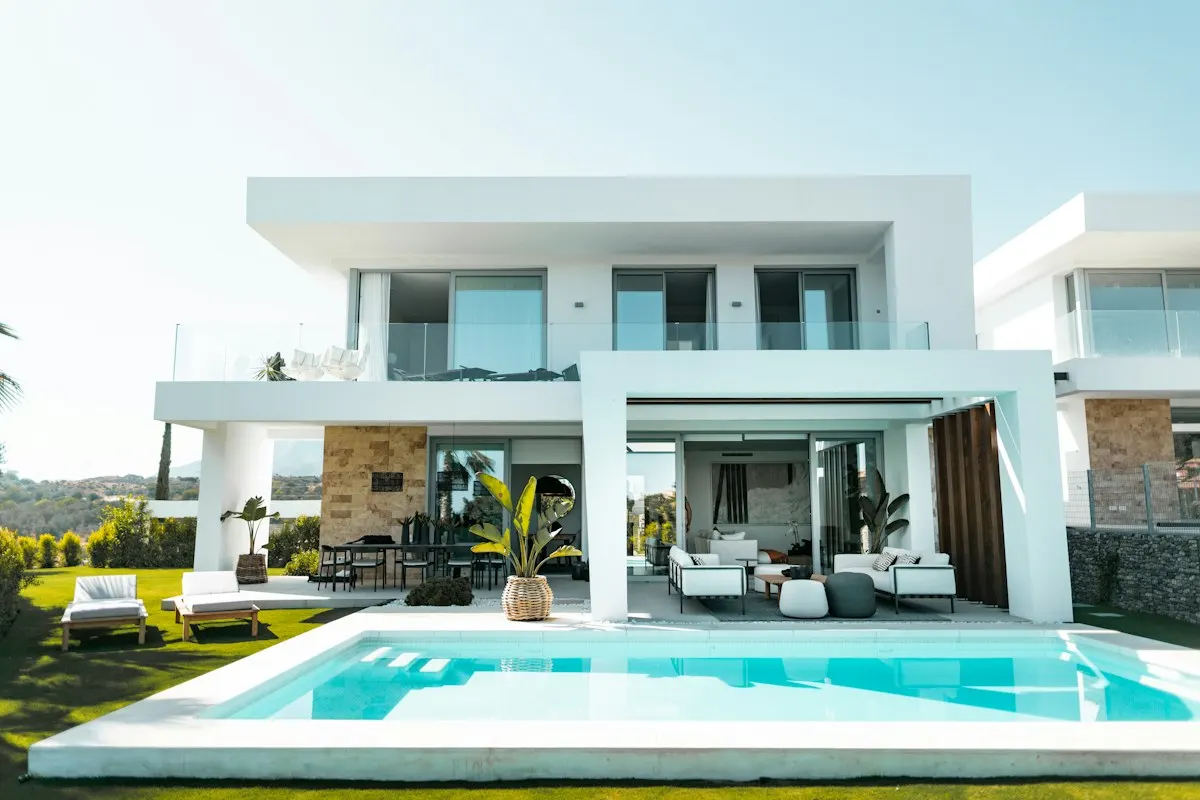
Photo: John Fornander · License.
Sanitizer choice is one of the easier decisions to change later, but it is cheapest to make at the build stage, when the cell and controls can be plumbed and wired from the start. HomeAdvisor's 2026 guide puts the average saltwater pool at $25,000, and Fixr prices a salt system added to a new build at $1,008 to $2,620.
This page looks at who each option suits, the ten-year cost, climate, effects on the rest of the pool, and what to ask in a proposal. The materials guide places the sanitizer among the other equipment choices. Because the decision interacts with the deck, coping, heater and pump schedule, it is worth making alongside those choices rather than as an afterthought at startup.
A salt system makes chlorine from dissolved salt in a cell on the equipment pad, so the water is chlorinated but feels softer and needs fewer chemical purchases. Traditional chlorine is dosed by tablets or liquid. HomeAdvisor's 2026 guide prices a conversion at $500 to $2,500 and salt-and-chemical costs around $100 a year.
| Factor | Saltwater chlorine generator | Traditional chlorine |
|---|---|---|
| Upfront cost | $1,008 to $2,620 added to a new build (Fixr 2024); conversion $500 to $2,500 (HomeAdvisor 2026) | Chlorinator or feeder $100 to $500 |
| Lifespan | Cell replaced every 5 to 7 years at $200 to $700 (Fixr / Bob Vila) | Feeder lasts years; consumables ongoing |
| Maintenance and consumables | About $100 a year salt and chemicals (HomeAdvisor); cell cleaning; ~$50 a year electricity | Several hundred dollars a year in tablets or liquid; regular dosing |
| Water feel | Softer, less odor, gentler on eyes and skin | Standard chlorine feel; odor when chloramines build |
| Climate fit | Cells slow below about 60°F water; fine in warm climates | Works at any temperature |
| Install time | Hours at build; a day to convert | Hours |
| Effect on materials | Salt splash can pit soft stone and corrode steel walls or fixtures | Neutral to hardscape; strong chlorine can fade liners |
| Best for | Warm climates, long seasons, owners tired of buying chlorine | Short seasons, soft-stone decks, minimum upfront spend |
Salt wins in a long season. The cell runs whenever the pump runs, so a Sun Belt pool that swims ten months gets the most value from the lower consumable cost, and the water feel is the reason most owners cite. HomeAdvisor's $25,000 average for a saltwater pool new is about the same shell with a $1,000 to $2,600 cell, so at build it is a small add-on. Choose the deck with salt in mind: dense pavers or sealed concrete rather than soft limestone.
Chlorine wins in a fourteen-week Midwestern season, where the cell would sit idle for eight months and the consumable savings are small. It also wins on a vinyl pool with steel walls or a deck of soft flagstone. Either way, ENERGY STAR's point stands that the pump schedule drives the electric bill, not the sanitizer; see the calculator for the add-on cost.
Salt systems suit pools that run many months a year, owners who want less chemical handling, and swimmers who notice red eyes or dry skin with traditional chlorine. The generator produces chlorine steadily, which keeps levels more even and reduces the peaks and valleys of manual dosing. Families who swim daily in warm climates tend to appreciate the difference most. Our analysis of EIA's 2024 household survey found 47.7% of U.S. pool homes use the pool all year and 41.9% one to six months, which roughly splits the country between the two answers.
Traditional chlorine suits short seasons, budget-focused builds, pools with natural stone coping or decks sensitive to salt, and owners who prefer simple, well-understood equipment. It also works well when water temperature is often cool, since salt cells produce less chlorine in cold water. Many northern owners find traditional chlorine simpler for a three-month season; by the same survey, 94.88% of Northeastern pool homes use the pool one to six months.
Salt systems cost more upfront and need a cell replacement every few years, which the comparison table prices from Fixr and Bob Vila figures. In exchange, chemical purchases drop sharply. HomeAdvisor estimates salt and related chemicals around $100 a year, compared with several hundred dollars a year for tablets or liquid chlorine in a typical pool, both inside HomeAdvisor's overall maintenance range of $960–$1,800 per year.
Over ten years, the two options often land in a similar range, with salt slightly ahead in warm climates where the pool runs long seasons and chlorine demand is high. In short-season pools, the cell replacement cost weighs more heavily against the smaller chemical savings. The calculator includes a salt add-on to help frame the upfront difference.
Salt cells perform most efficiently in warm water and slow down as water temperature drops. In pools that are open only in summer, this rarely matters. In pools used into cool shoulder seasons, owners may need to supplement with liquid chlorine. Traditional chlorine works at any temperature, which makes it predictable for northern pools.
In hot, sunny climates, chlorine demand rises because sunlight breaks chlorine down. A salt system replaces that chlorine continuously, which is one reason salt is popular in the South and West. The EIA found 63.15% of Southern pool homes use the pool all year, the kind of long season where salt tends to pay back.
Salt water splashing onto soft stone, some concrete finishes and certain metals can cause pitting, scaling or corrosion over time. Sealing stone coping and decks, choosing salt-rated materials and rinsing surfaces reduce the risk. Steel pool walls, some heaters and older metal fixtures deserve attention in a salt pool. Ask the builder which components on your equipment list are rated for salt use.
Traditional chlorine is less aggressive to hardscape, though strong chlorine can fade vinyl liners and some finishes. Whichever you choose, balanced water chemistry does more to protect the pool than the sanitizer type. The deck comparison covers materials that tolerate salt well. Proper pH and alkalinity protect plaster, tile and liners under either system.
With salt, the most common mistake is assuming it is maintenance-free. Cells still need cleaning, salt levels need checking, and pH tends to rise, so acid additions are routine. Another mistake is pairing salt with soft stone without sealing it. Undersizing the cell for the pool volume or climate also leads to disappointment.
With traditional chlorine, the most common mistakes are inconsistent dosing, letting chloramines build up, and storing chemicals poorly. Automated feeders help keep levels steady. HomeAdvisor notes saltwater pools average only about $100 a year in salt and chemicals, but that low figure assumes steady dosing. In either case, testing water weekly and balancing it properly protects swimmers, surfaces and equipment. The sanitizer poll shows what other planners are choosing. Ask the builder to show you how to test and adjust the water before the first swim.
Homeowner polls
No votes yet. Yours will be the first. · saved on this device
EIA's 2024 survey found 77% of Western pool homes swim year-round versus a small minority in the Northeast.
No votes yet. Yours will be the first. · saved on this device
No. The cell converts salt to chlorine, so the water is a chlorine pool with a lower, steadier level and no added stabilizer from tablets. Salinity is about a tenth of seawater, low enough that most people do not taste it.
Modern heaters, pumps and lights are rated for salt pools. Older heaters with copper heat exchangers and unsealed metal fixtures can corrode. If converting an existing pool, ask the pro to check the heater exchanger and the ladder anchors, and ensure the bonding grid is intact.
Fixr and Bob Vila give 5 to 7 years, sooner with high use or poor pH control, at $200 to $700. Keep pH in range and clean the cell of scale two or three times a season to reach the long end.
Many swimmers find salt pools gentler on eyes and skin because chlorine levels stay steadier and fewer chloramines form. The water is still chlorinated, so people sensitive to chlorine may still notice it. Balanced pH matters as much as sanitizer type. If sensitivity is a concern, ask to swim in a friend's salt pool before deciding.
Yes. Converting an existing pool to salt usually means installing a cell and control unit on the equipment pad and adding salt to the water. HomeAdvisor prices conversions at $500 to $2,500. Before converting, check that deck, coping and metal components tolerate salt, and that the pool's equipment is compatible.
Salt pools usually run at salinity well below seawater, so most people notice only a faint taste, if any. The water often feels softer. Owners who expect ocean-like water are sometimes surprised by how mild it is. The exact salt level depends on the cell manufacturer's recommendations.
Salt pools need less chemical buying and dosing, but they still need weekly testing, pH control, cell cleaning and occasional salt additions. Traditional chlorine pools need regular dosing but no cell care. Overall effort is similar, but salt pools tend to feel easier because chlorine levels stay more stable between checks.
Yes. Salt cells produce chlorine only when water flows through them, so the pump schedule must provide enough run time for adequate chlorine. Variable-speed pumps work well with salt when the controller coordinates pump speed and cell output. Ask the builder to program the system so the cell gets enough flow without wasting pump energy.
 ComparisonGunite (concrete) pool vs Fiberglass pool
Choose gunite if you want a custom shape, an integrated raised spa, a sloped-lot design or an infinity edge, and you accept a longer build and periodic resurfacing.
 ComparisonFiberglass pool vs Vinyl liner pool
Pick vinyl if the upfront budget is tight, you want a custom shape without gunite pricing, or your season is short.
 ComparisonIn-ground spa vs Portable hot tub
Choose an in-ground spa if you are building a pool and want the spa to share its equipment and double as a water feature.
 ComparisonPoured concrete deck vs Paver or travertine deck
Choose poured concrete for the lowest cost per square foot, large areas and a smooth continuous surface, knowing it will crack at some point and needs sealing.
 ComparisonNatural gas heater vs Electric heat pump
Choose a gas heater if you need fast heat for a spa, swim mainly on weekends, or live where spring and fall air is cold.
 Service guideCustom Pool Design & Build
Custom pool design and build covers everything from the site plan to first swim: excavation, the shell in gunite, fiberglass or vinyl, equipment and plumbing, electrical and bonding, the barrier, startup and training.
 Service guideSpa & Hot Tub Installation
Spa and hot tub installation covers the base, the delivery route, the dedicated electrical circuit with GFCI protection, drainage around the unit, and the cover and access arrangement that make it usable every week.
 Service guideWater Features & Waterfalls
Water features add sound and motion to a pool through sheer descents, bubblers, deck jets, scuppers, spillover spas or rock waterfalls.
 Service guidePool Decking & Coping
Pool decking and coping form the transition from water to yard: the coping caps the bond beam and the deck carries foot traffic and sheds water.
 Free toolInground pool cost calculator
Size, material tier and complexity in, a realistic budget range out.
 Free toolPool planning quiz: nine things to know before the first site visit
9 questions that show what you already know and what to check next.
 Free toolPool planning polls
See what other planners chose and add your vote.
Tell us the size, the condition of what is there now, and what you want to change. Pool Plan Compass passes your request to independent local professionals, who reply with written, no-obligation estimates. The service is free to use.