Which water feature appeals most?
No votes yet. Yours will be the first. · saved on this device
Loading...
Pool Plan Compass · Service guide
Water features add sound and motion to a pool through sheer descents, bubblers, deck jets, scuppers, spillover spas or rock waterfalls. Each pulls flow from the circulation system or a dedicated pump and changes evaporation, noise and cleaning. This service suits owners who have defined the effect they want and confirmed the equipment can support it, whether on a new build or an existing pool.
A waterfall is a plumbing decision dressed up as a landscape decision. Every feature needs a set flow rate at a set head, and that flow either comes off the main return manifold, which reduces what reaches the pool, or from its own pump, which adds a circuit and a line item. Bob Vila's 2026 guide prices pool water features at $450–$5,000, and that range covers a single bubbler at the bottom to a multi-tier rock fall at the top.
The features most people regret are the ones chosen from a photo: a rock waterfall that sounds like a highway, a sheer descent that splashes the deck, a grotto nobody cleans. This page walks through what each type costs, how it plumbs, what it does to your water bill and your evenings, and what to ask the pro you hire before the trench is dug. For the rest of the pool scope, the design and build page covers the whole yard.
Want the numbers only? Read the water features & waterfalls cost guide for 2026 ranges, what moves the price, and sample budgets.
| Item | Low | High | Unit | Notes |
|---|---|---|---|---|
| Bubbler, installed on ledge | $450 | $1,200 | flat | Bob Vila 2026 low end |
| Deck jets, per pair | $800 | $2,000 | flat | |
| Sheer descent, 18 to 36 inch | $1,000 | $3,000 | flat | Plus raised wall if none exists |
| Rock waterfall | $3,000 | $15,000 | flat | Natural stone at the top of range |
| Dedicated feature pump and circuit | $1,200 | $3,000 | flat | Variable-speed pump plus electrical |
| LED feature lighting | $1,000 | $2,000 | flat | Fixr |
| Infinity edge | $20,000 | $26,000 | flat | Fixr; catch basin and structure |
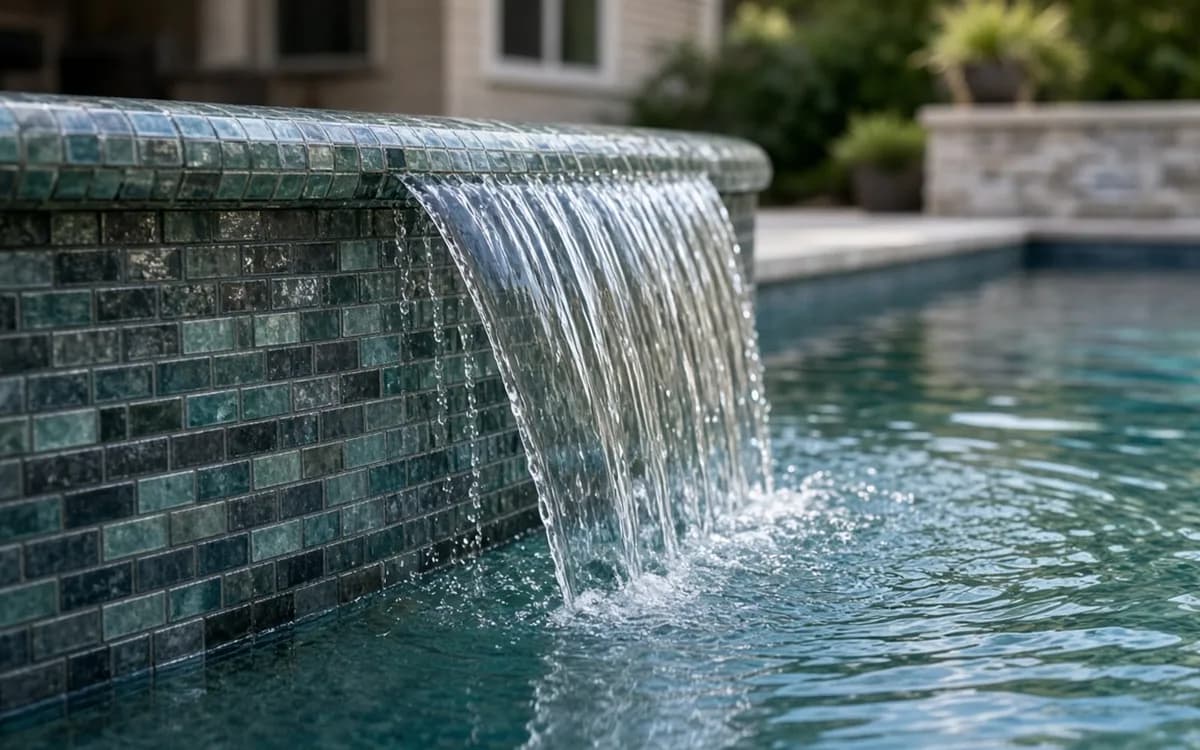
Sheer descents are slot nozzles set in a raised wall that produce a flat sheet of water, quiet at low flow and loud at high. Bubblers sit on a tanning ledge and push a low dome of water a few inches high, mostly for kids and for the look. Deck jets arc a thin stream from the coping into the pool. Scuppers and spouts are single-point falls from a wall or a bowl. A spillover spa is the most common feature of all because it comes with the spa.
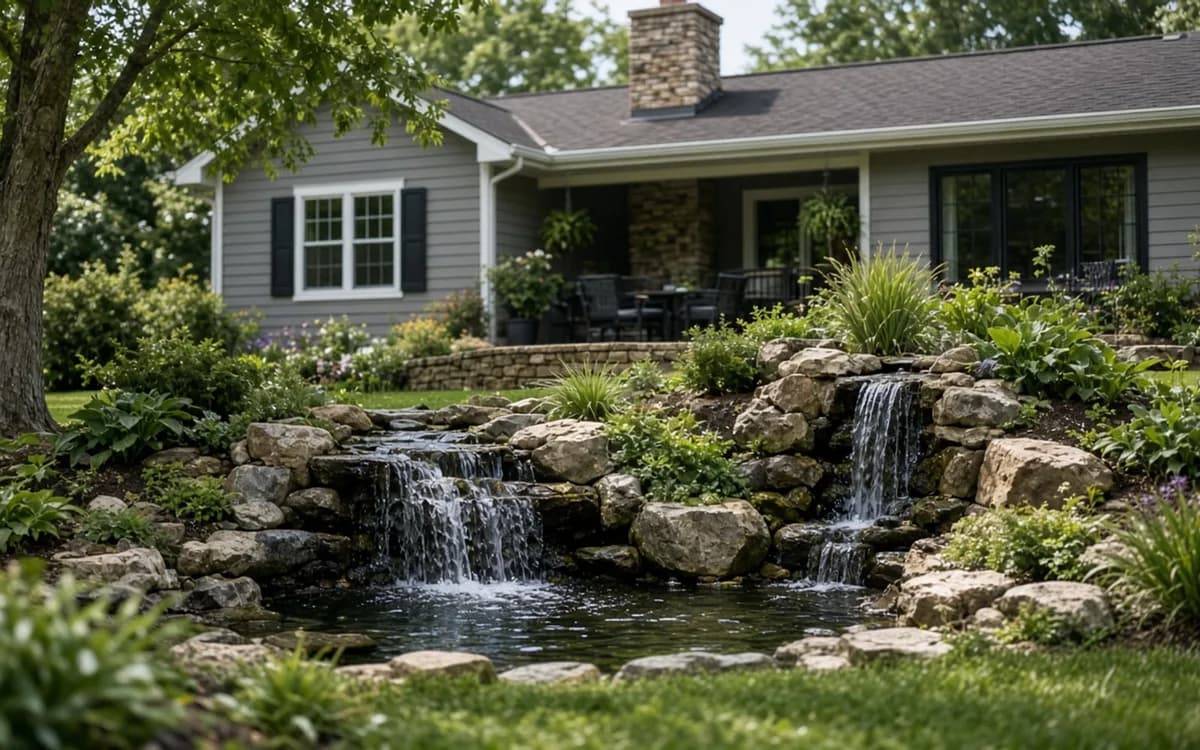
Rock waterfalls are built from real stone or cast artificial rock over a shotcrete or block form, with a weir at the top and a basin or the pool itself at the bottom. They are the loudest, the most expensive, and the hardest to clean. Fixr's guide itemizes lighting at $1,000 to $2,000 and notes an infinity edge, the ultimate water feature, at $20,000 to $26,000 or more. Every one of these is a choice about sound as much as sight.
| Feature | Typical cost added | Noise | Flow source |
|---|---|---|---|
| Bubbler on ledge | $450 to $1,200 | Low | Return manifold branch |
| Deck jets (per pair) | $800 to $2,000 | Low to medium | Return branch or small pump |
| Sheer descent (18 to 36 in) | $1,000 to $3,000 | Adjustable | Dedicated valve, often own pump |
| Spillover spa | Part of spa cost | Medium | Spa return |
| Rock waterfall | $3,000 to $15,000+ | High | Dedicated feature pump |
| Infinity / vanishing edge | $20,000 to $26,000+ | Low to medium | Catch basin and own pump |
The main pump has a job: turn the pool's volume over through the filter in six to eight hours. ENERGY STAR notes that running the filter 6 hours a day instead of 24 cuts pump energy by 75%, but that math only works if the pump is not also feeding a waterfall at full speed. A single bubbler or a pair of deck jets can ride on a valved branch of the return line. A sheer descent wider than 24 inches or any rock fall wants its own pump so the pool can filter on low speed while the feature runs on demand.
Variable-speed pumps changed the arithmetic. Pentair notes the 2021 Department of Energy rule made variable speed the default, with savings of up to 90% on pump energy. Yet our analysis of EIA's 2024 household survey found 48.2% of pool homes still report no variable-speed pump, 73.4% in the Northeast against 18.8% in the West. A feature pump on a schedule, running two hours in the evening, adds little to the bill; the same feature run all day on a single-speed pump can add hundreds of dollars a year. Ask for a plumbing schematic that shows each feature's valve and pump.
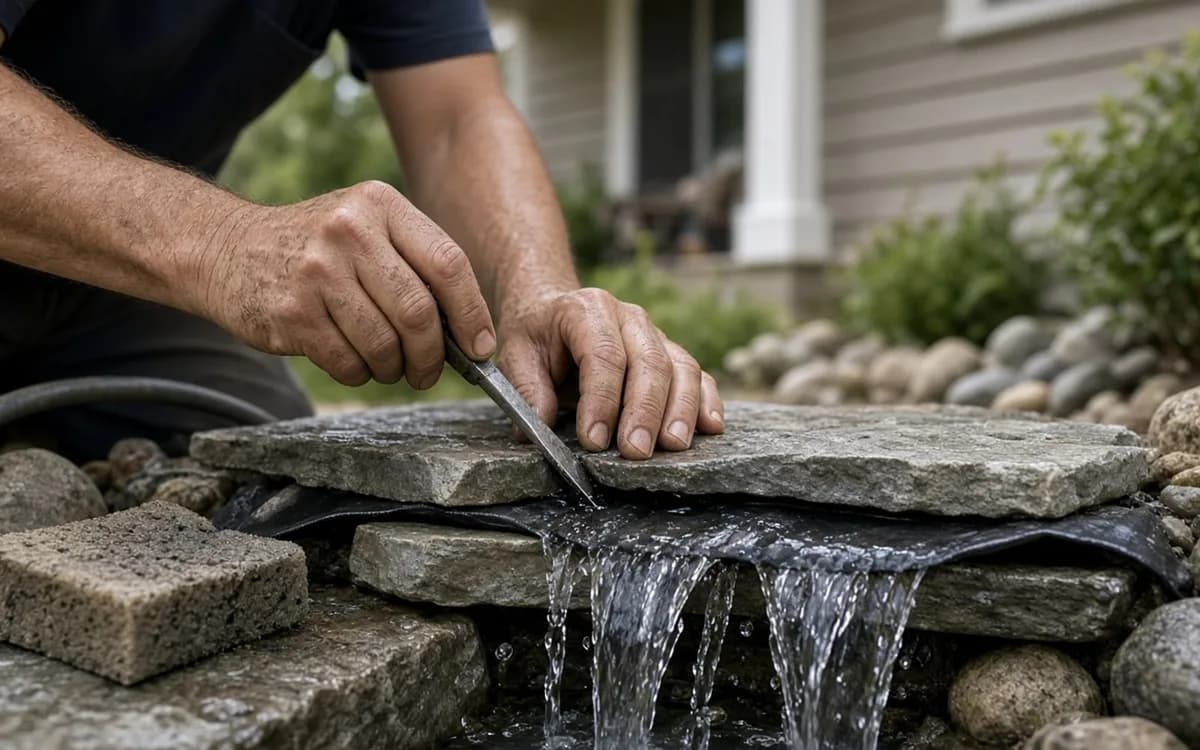
Moving water evaporates faster than still water, and a sheet of water falling through air evaporates faster still. In a dry climate a large sheer descent running all afternoon can measurably raise water use and heating cost, since the falling water sheds heat. HomeAdvisor's 2026 maintenance guide puts general pool upkeep at $960–$1,800 per year, and features push toward the top of that range through extra chemical demand, extra water, and the pump hours.
Our analysis of EIA's 2024 survey found 35.8% of U.S. pool homes report a heating fuel, rising to 49.6% in the West, the highest of any region, which is exactly where evaporation from features costs the most. Run features on a timer, use them when you are outside, and use a cover the rest of the time. Pool Goods' 2026 modeling shows variable-speed pump savings from $477 a year in the Pacific Northwest to $1,743 in Hawaii on electricity rates alone, so the pump schedule matters more where power is expensive.
Calcium scale on the weir lip is the first thing you see on a sheer descent or a rock fall in hard-water regions: a white crust that breaks the sheet into fingers within a season. Second is algae in a basin or on shaded rock, because the feature's water sits still when the pump is off. Third is nozzle clogging on bubblers and deck jets from debris that bypasses the skimmer. None of these are structural, but all of them are weekly chores if the feature was designed without access.
Ask for a removable weir on descents, a cleanout on any feature line, a basin drain on rock falls, and a location that can be reached with a brush without climbing on wet stone. If nobody in the household will do that work, choose a bubbler over a grotto. The planning polls show how often owners say their feature gets used versus how often it gets cleaned, which is a useful reality check.
Sound scales with height, flow and what the water lands on. A 24-inch descent at low flow is a murmur; a five-foot rock fall at full flow can drown out conversation on the deck and irritate a neighbor across the fence. Before committing, listen to a built example of the same feature at the same drop, or ask the pro you hire to run a temporary hose over the intended wall at the intended flow so you hear it in your own yard.
Design for control. A feature on a variable-speed pump can be dialed from a trickle to a torrent, and a manually valved descent can be set once and left. Place the loudest element farthest from the seating you use most and from bedroom windows. If the goal is to mask road noise, a wider, lower sheet does the job better than a tall single spout.
Yes, and this is a common midlife upgrade. The work is trenching from the equipment pad to the feature location, cutting and patching deck concrete where the line crosses, adding a valve or a pump, and building the feature itself. A raised wall for a descent can be built on the existing bond beam if the shell is sound; if the deck or tile line is due for replacement anyway, doing the feature at the same time avoids cutting new concrete twice. Bob Vila's 2026 remodeling guide prices water features at $450–$5,000, and a feature retrofit is a natural bundle with retiling.
The limit is the equipment pad. Every add-on competes for it, from a salt cell to an automatic cover at $8,000–$20,000, and each one draws power and space. If the pad already has an aging single-speed pump, replacing it with a variable-speed model as part of the feature project is usually the better sequence. Ask for a hydraulic check before the feature is priced.
Expect a drawing showing the feature location, the drop height and the weir width; a flow rate in gallons per minute; the pump or valve that supplies it; the electrical circuit if a pump is added; the material of the wall or rock and how it is finished; and the cleaning access described above. Expect a note on where splash goes and how the basin drains for winterizing in freeze climates.
Compare feature proposals on those items rather than on price alone, because a low bid that branches a waterfall off the main return without a dedicated pump will cost you filtration and energy for years. The comparison pages include a sheer descent versus rock waterfall matchup, and the estimate request lets you attach a photo of the wall or ledge you have in mind.
Homeowner polls
No votes yet. Yours will be the first. · saved on this device
No votes yet. Yours will be the first. · saved on this device
 Service guideCustom Pool Design & Build
Custom pool design and build covers everything from the site plan to first swim: excavation, the shell in gunite, fiberglass or vinyl, equipment and plumbing, electrical and bonding, the barrier, startup and training.
 Service guideSpa & Hot Tub Installation
Spa and hot tub installation covers the base, the delivery route, the dedicated electrical circuit with GFCI protection, drainage around the unit, and the cover and access arrangement that make it usable every week.
 Service guidePool Decking & Coping
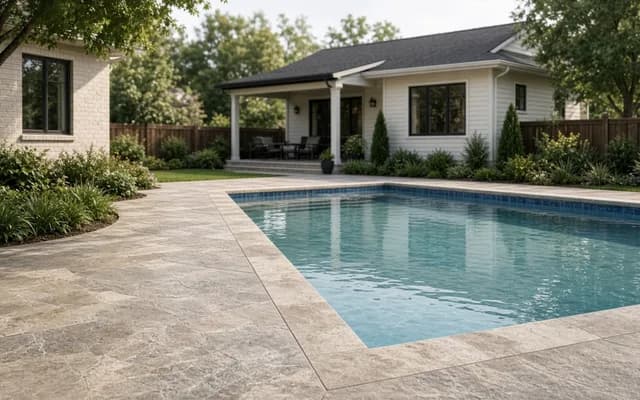
Pool decking and coping form the transition from water to yard: the coping caps the bond beam and the deck carries foot traffic and sheds water.
Yes, noticeably in dry or windy conditions. Falling water sheds heat through evaporation, so a large sheer descent or waterfall running for hours can lower the temperature a degree or two and raise heating costs. In hot climates that is sometimes welcome; in shoulder seasons it fights the heater. Run features when you are using the pool and keep them off overnight.
The water recirculates, so the feature itself does not consume water. What it adds is evaporation, which depends on surface area, air temperature, humidity and wind. A wide sheet in a Phoenix afternoon can add measurable inches a week; a bubbler in Ohio adds almost nothing. An automatic fill line and a cover for hours the feature is off keep it manageable.
Yes. Manufacturers offer raised-wall and spillover options, and a rock or wall feature can be built on the concrete collar behind the shell. The plumbing comes off the equipment pad like any other feature. The one caution is weight: heavy stone should bear on its own footing, not on the shell edge. Ask how the wall is supported.
A single spout that projects from a wall and drops a rounded stream into the pool, usually in copper, stainless or stone. Scuppers are quieter than a rock fall and simpler than a sheer descent, and three or four along a raised wall are a common design. Each needs a small dedicated line, so plan the count before the wall is shot.
Somewhat. Aeration raises pH, so a pool with a large waterfall running daily needs more acid to hold balance, and the extra evaporation concentrates calcium over time. Neither is dramatic on a well-managed pool. A saltwater system does not change this; the cell still needs pH held in range.
The feature line is blown out and plugged like the returns, the basin is drained, and any pump above grade is drained or removed. Sheer descent nozzles should be removed and stored so ice cannot crack the housing. Ask the pro you hire to label the feature valves and include the feature in the closing checklist.
Both. The spa overflows through a weir into the pool whenever the spa return is open, which gives you the sound and look of a small descent while heating the spa. Because it uses spa plumbing, it adds no separate feature line, which makes it the most cost-efficient feature on a new build. The trade-off is that the spa runs cooler when the spillover is on.
It should be. A properly plumbed feature has an isolation valve or its own pump, so closing it returns all flow to the pool. If a builder proposes a waterfall tee'd straight off the main return with no valve, the feature will run whenever the filter runs and cannot be adjusted. Insist on the valve; it costs almost nothing during construction.
 Free toolInground pool cost calculator
Size, material tier and complexity in, a realistic budget range out.
 Free toolPool and spa comparisons, decided by your conditions
Side-by-side tables for the decisions that change the price most.
 Free toolPool planning quiz: nine things to know before the first site visit
9 questions that show what you already know and what to check next.
 Free toolPool planning polls
See what other planners chose and add your vote.
Tell us the size, the condition of what is there now, and what you want to change. Pool Plan Compass passes your request to independent local professionals, who reply with written, no-obligation estimates. The service is free to use.