What is the primary use for the water?
Drives size, depth, heating and whether a spa is the better project.
No votes yet. Yours will be the first. · saved on this device
Loading...
Pool Plan Compass · Services
Four scopes cover most backyard water projects: a complete inground pool design and build, a spa or hot tub as an attached or standalone unit, water features tied into the circulation system, and the decking and coping that form the edge. This hub explains who each suits, what drives its cost, and when a smaller scope is the smarter one.
Not every household needs a pool. EIA's 2024 Residential Energy Consumption Survey found 7.25% of occupied U.S. homes have a swimming pool and 7.61% have a hot tub, with only 2.1% owning both. Those are installed-stock figures, not annual purchases, and our analysis of the same survey found 69.1% of hot-tub homes report no pool, so a spa alone is a common end point for a family that mostly wants to soak.
The chooser below is organized around the mistake that costs the most: buying a finish or a feature from a photo before the site, the barrier and the equipment have been planned. If you are unsure which scope fits, the planning quiz sorts it out in a few minutes.
 Service guideCustom Pool Design & Build
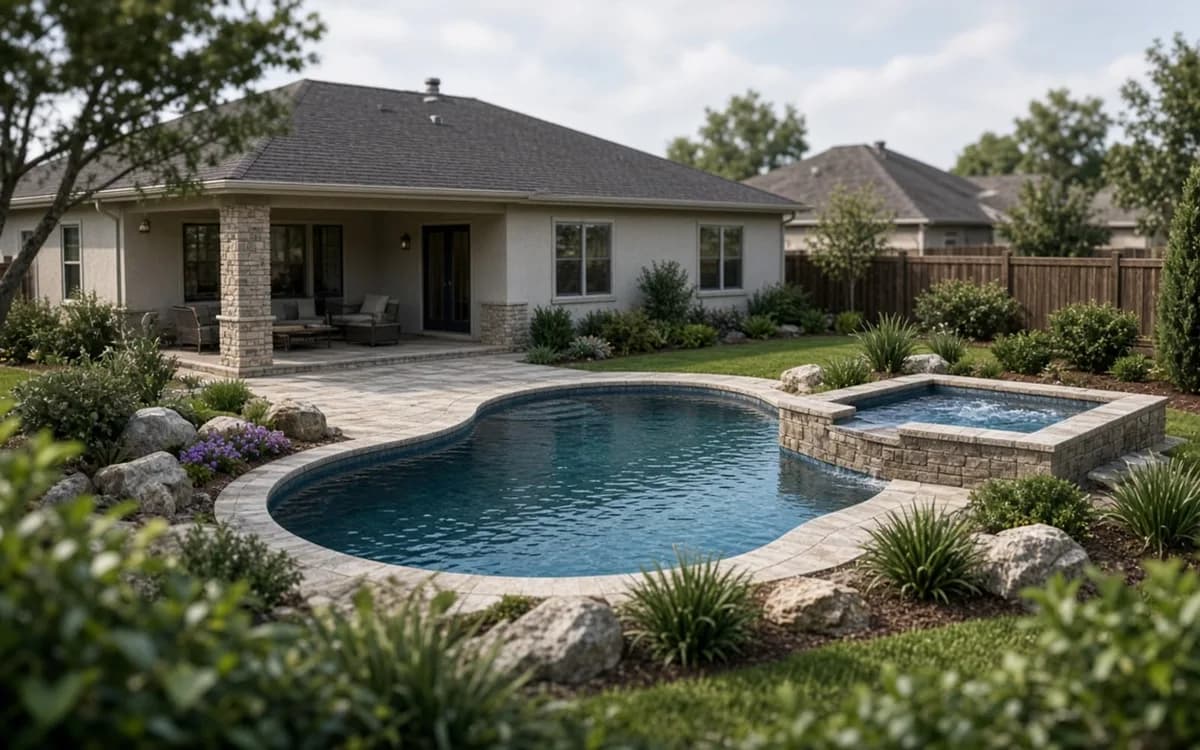
Custom pool design and build covers everything from the site plan to first swim: excavation, the shell in gunite, fiberglass or vinyl, equipment and plumbing, electrical and bonding, the barrier, startup and training.
 Service guideSpa & Hot Tub Installation
Spa and hot tub installation covers the base, the delivery route, the dedicated electrical circuit with GFCI protection, drainage around the unit, and the cover and access arrangement that make it usable every week.
 Service guideWater Features & Waterfalls
Water features add sound and motion to a pool through sheer descents, bubblers, deck jets, scuppers, spillover spas or rock waterfalls.
 Service guidePool Decking & Coping
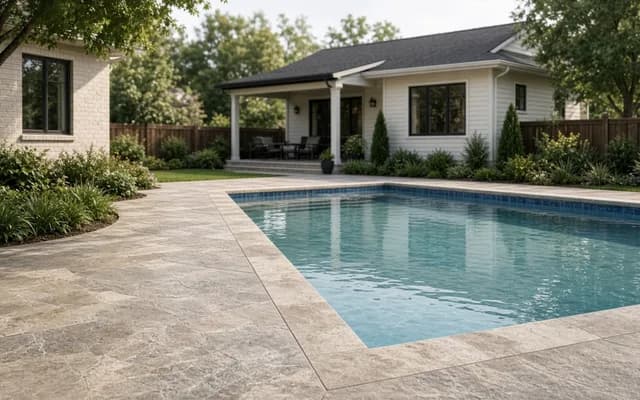
Pool decking and coping form the transition from water to yard: the coping caps the bond beam and the deck carries foot traffic and sheds water.
| Service | Best for | Skip it if |
|---|---|---|
| Custom Pool Design & Build | A household that will swim, play or host regularly for years, with room for excavation access and a barrier, and a budget that covers the surround and equipment, not just the shell. | Your main use is hot soaking, your yard has no equipment access, or the total budget is under roughly $40,000 once decking and fencing are included. |
| Spa & Hot Tub Installation | Year-round relaxation, cold climates where a pool would sit covered half the year, and small yards where a 7 by 7 foot pad and a 50-amp circuit are the whole footprint. | You want to swim laps or host pool parties, or the only spot for the unit has no level base and no way to run a dedicated circuit. |
| Water Features & Waterfalls | Owners who want sound and movement, have decided how loud is too loud, and have a circulation system or a dedicated pump that can support the flow without starving the filter. | You are choosing an effect from a photo, your equipment pad is already undersized, or nobody in the household will clean the feature's basin and nozzles. |
| Pool Decking & Coping | Any new pool, and any existing pool whose edge is chipped, whose deck ponds water toward the house, or whose surface is too hot to walk on barefoot in July. | The shell is moving, cracked or leaking; fix the structure first, because new coping on a shifting bond beam will crack again. |
By the numbers
7.25%
of occupied U.S. homes have a swimming pool (about 9.6 million households)
EIA's 2024 survey estimates 9,604,000 occupied primary residences with a pool. This is installed stock, not annual purchases; new construction runs about 60,000 pools a year by Pool Corporation's estimate.
EIA 2024 Residential Energy Consumption Survey (preliminary microdata, May 2026) (2024)7.61%
of occupied U.S. homes have a hot tub (about 10.1 million households)
EIA's 2024 survey counts 10,084,000 hot-tub homes, slightly more than pool homes. Installed stock, not sales; the standalone spa is a mainstream purchase rather than a pool accessory.
EIA 2024 Residential Energy Consumption Survey (preliminary microdata, May 2026) (2024)$6,000
A new hot tub averages $6,000 installed; typical range $2,000–$11,000
HomeAdvisor's 2026 tiering runs entry-level $2,500–$5,000, value $5,000–$8,000, premium $8,000–$11,000 and luxury $11,000+. Expect $20–$30 a month in electricity and $500–$1,000 a year in maintenance.
HomeAdvisor, Hot Tub Prices (2026)$450–$5,000
Pool water features such as waterfalls and fountains cost $450–$5,000 to add
Bob Vila's 2026 pool remodeling guide prices water features alongside LED lighting at $450–$1,700 and slides at $1,000–$15,000. Sheer descents and bubblers sit at the low end; custom rock waterfalls and grottos run far higher.
Bob Vila, Pool Remodel Cost (2026)A new inground pool is the largest scope by an order of magnitude. Angi's 2026 benchmark is $65,909, and it involves excavation, a dumpster, a concrete pump or a crane, and weeks of open trench in the yard. A standalone hot tub sits at the other end: HomeAdvisor's 2026 guide puts a new unit at $6,000 installed, with the work done in a day once the pad and the 240-volt circuit are ready.
Water features and decking fall in between and are usually bought as part of the pool build, though both can be added later. Bob Vila's 2026 guide prices pool water features at $450–$5,000, while Concrete Network prices concrete pool decks at $6–$18+ per sq ft. The disruption of adding either to an existing pool is mostly trenching and, for features, a second pump or a valve on the return line.
| Scope | Typical U.S. range | Disruption |
|---|---|---|
| Custom pool design and build | $44,499 to $87,349 pool; $95,000+ full package | 2 to 6 months, heavy equipment |
| Spa or hot tub installation | $2,000 to $11,000 portable; $5,000 to $25,000 in-ground | 1 day to 3 weeks |
| Water features and waterfalls | $450 to $5,000 typical; rock work far higher | Days, plus plumbing changes |
| Decking and coping | $6 to $18+ per sq ft concrete; $12 to $45 stone | 1 to 2 weeks |
If the honest answer to 'how will you use the water' is thirty minutes of hot soaking after work, a pool is the wrong tool. EIA's 2024 survey found 42.2% of Northeastern hot-tub homes use the tub all twelve months, while the region's pool homes overwhelmingly report one to six months of use. A spa runs year-round in cold climates; a pool mostly sits under a cover. The spa and hot tub page covers the pad, delivery route and electrical work that decide whether a portable unit is a one-day job or a three-week one.
The reverse is also true. Families with school-age children who want play, laps and friends over need water volume and shallow area, and an attached spa can be added to the pool design at HomeAdvisor's $2,000–$35,000 range. Decide the primary use first and let the secondary use ride along as an option line.
Every one of these projects touches electricity and water at the same time, so every proposal should name who does the bonding and grounding, who pulls the electrical permit, and which inspections occur before the trench is backfilled. Every scope also changes drainage: a pool deck sheds water somewhere, a spa pad needs a level base with runoff, and a waterfall splashes outside the pool. Ask where the water goes.
Finally, every scope needs a handover. Startup chemistry, equipment manuals, breaker labels and a walk-through of the automation are worth more in the first month than any finish upgrade. Pool Goods models a variable-speed pump saving $345–$735 per year against single-speed, and a clean handover that sets the pump schedule is where that saving starts. The estimate request asks you to state which of these you expect so that the pros who respond price them in. For a quick number on any scope, the pool cost calculator uses the same sourced ranges shown here.
Homeowner polls
Drives size, depth, heating and whether a spa is the better project.
No votes yet. Yours will be the first. · saved on this device
No votes yet. Yours will be the first. · saved on this device
Yes, and it is common. A sheer descent or bubbler runs on a valved branch of the existing return line if the pump has spare capacity, or on a small dedicated pump if it does not. The plumbing is trenched from the equipment pad to the feature location, so the cost depends on distance and on whether deck concrete must be cut and patched. A rock waterfall built onto a raised wall is a larger job that needs structural support and a plan for splash-out.
Yes. River Pools' 2025 guide gives fiberglass 2 to 6 weeks of installation against 3 to 6 months for concrete, and Today's Homeowner gives 3 to 4 weeks versus 8 to 12 once excavation begins. The catch is delivery: the shell arrives on a truck and is set with a crane, so a narrow side yard, overhead wires or a steep driveway can rule it out. Both types share the same permit, barrier and electrical steps.
Often yes for coordination, because coping must be set on the bond beam and the deck poured after the plumbing is pressure-tested. Some builders subcontract the deck at a markup, so ask whether decking is in-house. If you want travertine, pavers or a large patio, a hardscape specialist may be more competitive. Either way, one party must own the sequence and the finished elevations.
The thickened concrete ring at the top of a pool shell that stiffens the structure and carries the coping and tile. On gunite pools it is formed and shot with the walls; on fiberglass and vinyl pools a concrete collar does a similar job. Most tile and coping failures trace to movement or water intrusion at the bond beam, which is why decks are separated from it with an expansion joint.
HomeAdvisor's 2026 guides put an in-ground hot tub at $15,000 average, typically $5,000 to $25,000, against $6,000 average for a portable unit in the $2,000 to $11,000 range. In-ground adds excavation of about $2,000, shell, plumbing and finish; portable adds a pad, a circuit and delivery. The in-ground unit shares equipment with a pool if built together, which lowers its incremental cost.
A new pool always does, and an in-ground spa is treated as a pool. A portable hot tub usually needs only an electrical permit for the dedicated circuit, though some cities also require a barrier or a locking cover. Water features on an existing pool rarely need a permit unless they add a pump circuit. Decking often needs one if it exceeds a size threshold or changes drainage. Local rules vary widely.
Yes, and many owners do: shell, equipment and code-required barrier in year one, then upgraded decking, a feature or a spa in year two. The key is to stub plumbing and conduit for later features while the trench is open, which costs little now and a lot later. Tell every bidder which items are phase two so the base scope is comparable.
 Free toolInground pool cost calculator
Size, material tier and complexity in, a realistic budget range out.
 Free toolPool and spa comparisons, decided by your conditions
Side-by-side tables for the decisions that change the price most.
 Free toolPool planning quiz: nine things to know before the first site visit
9 questions that show what you already know and what to check next.
 Free toolPool planning polls
See what other planners chose and add your vote.
Tell us the size, the condition of what is there now, and what you want to change. Pool Plan Compass passes your request to independent local professionals, who reply with written, no-obligation estimates. The service is free to use.