Which deck material are you planning?
No votes yet. Yours will be the first. · saved on this device
Loading...
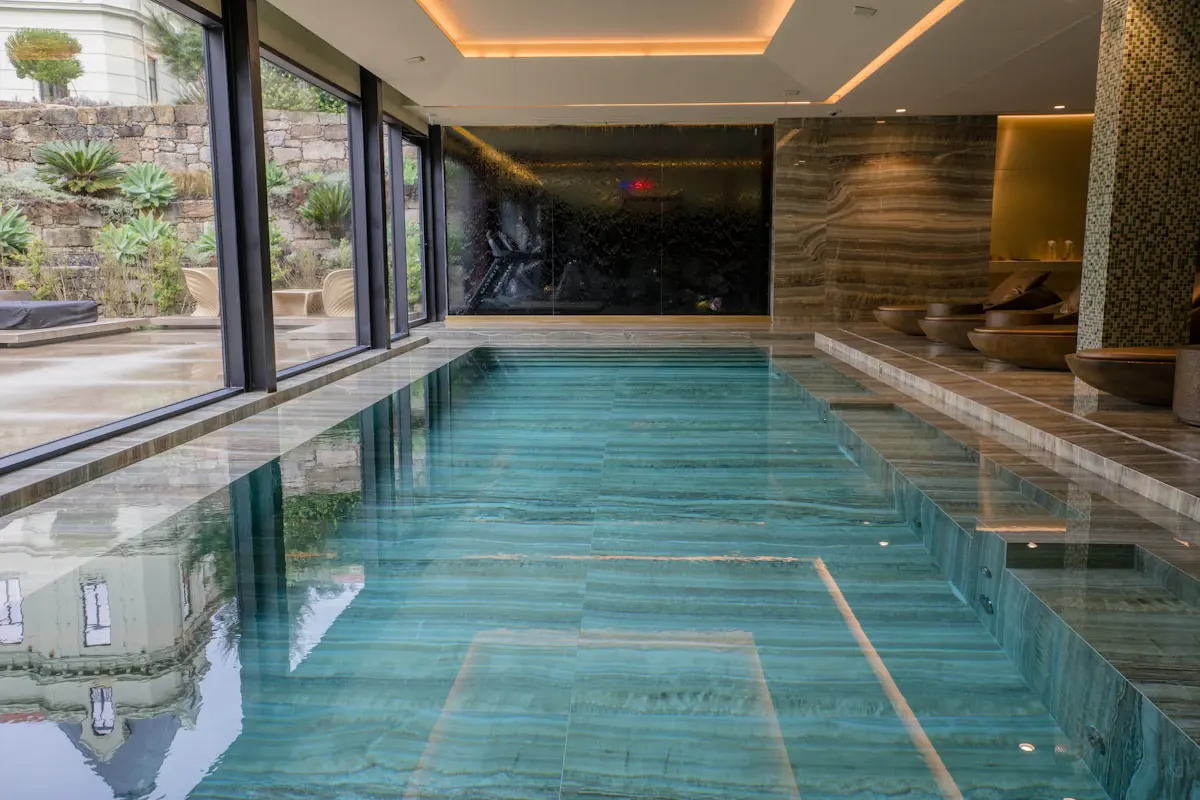
Pool Plan Compass · Poured concrete deck vs Paver or travertine deck
Choose poured concrete for the lowest cost per square foot, large areas and a smooth continuous surface, knowing it will crack at some point and needs sealing. Choose pavers or travertine for a cooler surface in hot sun, better freeze-thaw tolerance, easy spot repairs and a premium look. Concrete Network prices concrete pool decks at $6 to $18 or more per square foot.
Photo: Antonio Araujo · License.
The deck is the part of a pool project you touch most, and in many yards it covers more area than the pool itself. Concrete Network puts concrete pool decks at $6–$18+ per sq ft, and River Pools puts pool patios from basic concrete to luxury stone at $10–$50+ per sq ft. That range makes deck material one of the largest swing items in the whole budget.
This page compares the two surrounds on scenarios, ten-year cost, climate, resale and bid details. The decking and coping page covers coping, joints and drainage. Read both if the deck is a large share of your budget, since joint and drainage details decide how long either material looks good and drains well.
Concrete is poured as one slab, cheapest at Concrete Network's $6 to $11 per square foot for broom finish, and cracks where joints are missed. Pavers and travertine are set on a base at $12 to $45 per square foot, stay cooler, drain through the joints and can be lifted and reset.
| Factor | Poured concrete deck | Paver or travertine deck |
|---|---|---|
| Upfront cost | $6 to $11 broom; $11 to $18 stamped; $18+ elaborate (Concrete Network 2026) | $12 to $45 per sq ft stone pavers (Concrete Network); $20 to $50+ luxury stone (River Pools) |
| Lifespan | Decades; cracks and surface wear over time | Decades; individual units replaceable |
| Maintenance | Seal every 2 to 3 years; joint sealant at coping | Joint sand top-up; seal near water; occasional reset of settled units |
| Appearance | Monolithic; stamped patterns and color | Modular; natural stone variation; cleaner edge details |
| Climate fit | Freeze-thaw needs control joints and air-entrained mix; hot in dark colors | Handles freeze-thaw by moving; travertine stays cool in desert sun |
| Install time | 1 to 3 days to pour, a week to use, 28 days to cure | 1 to 2 weeks for 900 sq ft; usable immediately |
| Resale / ROI | Neutral | Travertine and stone read as premium in Sun Belt listings |
| Best for | Budget surrounds, large areas, cool-deck overlays | Hot climates, premium looks, sites with settlement risk |
Concrete wins on budget and on scale. A 900 square foot surround at $6 to $11 is $5,400 to $9,900, roughly half the paver figure, and a textured cool-deck overlay closes most of the heat gap for a few dollars more. It is also the only option that reads as one surface with cantilever coping. Get the control joints cut and the expansion joint at the coping done right and it lasts.
Pavers and travertine win in the Sun Belt, where deck temperature decides July usability and Realtor.com's 2025 data shows 61.8% of listings with a pool competing on finish. They also win on clay soils and anywhere settlement is likely, because a settled section is lifted and reset rather than demolished. The decking page covers the base and joint details that make either last.
Concrete suits large decks, tight budgets and owners who want a simple continuous surface for furniture and play. Broom finish is the most affordable. Stamped and colored concrete add pattern and color at a higher price. A cool-deck overlay can lower surface temperature in hot climates. Concrete is also fast to install, which helps when the pool schedule is tight.
Pavers and travertine suit hot climates, premium designs, and sites where soil may settle. Individual units can be lifted and reset, and the joints let water drain. Travertine stays notably cooler underfoot than dark concrete. The trade-off is a higher price per square foot and more joint maintenance. A mixed design, pavers near the water and concrete beyond, can balance cost and comfort.
Concrete starts cheaper, but it needs sealing every few years and eventually crack repair or resurfacing. Cracks cannot be invisibly patched, so a badly cracked deck often needs an overlay or replacement. Stamped concrete also needs periodic resealing to keep its color. Over ten years, these costs narrow the gap with pavers but rarely close it for a basic broom-finish slab. Concrete Network prices a 900 sq ft concrete deck at $5,400 to $16,200, and cracked hardscape can mean paying a share of that again.
Pavers start higher, but repairs are usually small: resetting a few settled units, replacing a chipped paver, topping up joint sand or sealing near the water. Travertine may need sealing to resist staining. Concrete Network prices stone pavers at $12 to $45 per sq ft installed, and joint sand and sealer are what protect that spend. The ten-year cost of pavers is usually close to the upfront price, while concrete's ten-year cost grows with each repair cycle. Use the decking cost page to price your square footage.
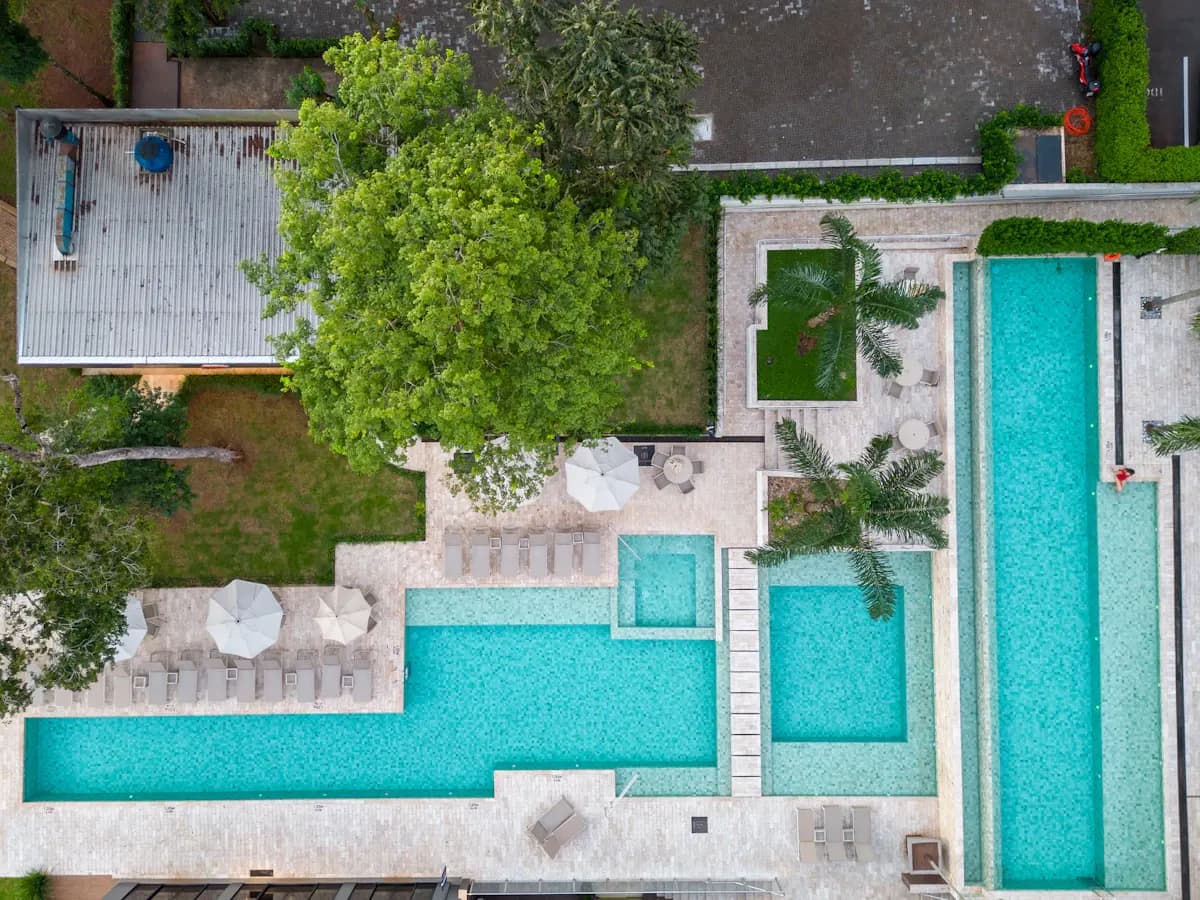
In hot climates, surface temperature matters. Dark or colored concrete can get uncomfortably hot, while light travertine and light pavers stay cooler. The Realtor.com Pool Premium report found 61.8% of Miami listings have a pool, with Phoenix and Orlando close behind, and in those markets travertine is common for exactly this reason. Our analysis of EIA's 2024 survey found 63.15% of Southern pool homes use the pool all year, against 47.7% nationally, so deck heat is a long-season question there.
In freeze-thaw climates, concrete needs control joints, air-entrained mix and good drainage to resist cracking and scaling. Pavers move with the ground and can be reset after heaving. Salt, both from salt pools and winter de-icing, can damage some concrete finishes and soft stones. Ask for materials rated for your climate and for salt exposure if you plan a salt system.
A clean, uncracked, well-drained deck helps any pool listing. Travertine and natural stone read as premium in Sun Belt listings, while a plain broom-finish slab reads as neutral. A cracked, stained or heaving deck is a visible defect that inspectors note and buyers use in negotiations. Inspectors also look at the joint between coping and deck, since a failed joint can signal water getting behind the tile line.
Because the deck is so visible, it often influences first impressions more than the pool finish. If you expect to sell within a few years, a premium surround near the water may be worth more than equipment upgrades buyers cannot see. The saltwater comparison explains how sanitizer choice affects stone.
For concrete, the most common mistakes are missing or poorly spaced control joints, poor base compaction, pouring against the coping without an expansion joint, and slopes that send water back toward the pool or house. Each leads to cracking or drainage problems within a few seasons. Ask for a joint layout and slope plan before the pour.
For pavers, mistakes usually involve the base: too thin, poorly compacted, or without proper edge restraint. Settling near the coping is the most visible failure. Using a paver or stone not rated for pool use can lead to spalling or slippery surfaces. Ask the installer about base depth, compaction method and edge restraints.
Every decking proposal should state square footage, material, finish, base depth, slope, drainage, joint layout and coping details. For concrete, ask about thickness, reinforcement, joint spacing and sealer. For pavers, ask about base material, depth, compaction, bedding layer, joint sand and edge restraint. Compare these line by line. A bid that omits base depth or joint layout is not cheaper; it is simply less specific, and the missing detail tends to reappear as a change order.
Also confirm the schedule relative to the pool. Deck work usually follows bonding inspections and coping, and it must be coordinated with the pool builder. If you hire separate trades, write down who is responsible for the joint between coping and deck. The calculator helps set a deck allowance in the overall budget.
Homeowner polls
No votes yet. Yours will be the first. · saved on this device
No votes yet. Yours will be the first. · saved on this device
Often yes, in a mortar bed or thin-set over a sound slab, which avoids demolition. The surface rises by an inch or more, so the coping height, door thresholds and steps must still work. A hardscape pro can check whether the slab is sound enough.
Texture matters more than material. Broom-finish concrete and tumbled travertine both grip well; smooth stamped concrete and polished stone do not. Ask for a slip-resistant finish near the water and avoid sealers that leave a gloss.
They can if the base is thin or poorly compacted, or if the edge restraint is missing. A 4 to 6 inch compacted gravel base, a proper edge and polymeric sand hold them. Salt splash can pit soft stone over years; dense travertine and concrete pavers handle it.
Many pool decks are poured around four inches thick on a compacted base, with thicker sections where vehicles or heavy loads are expected. Local soil, climate and reinforcement choices can change that. Ask the builder to state thickness, reinforcement and base depth in writing, since those details decide how well the slab resists cracking.
Pavers designed for pool decks usually have textured surfaces that stay grippy when wet. Polished stone, some sealers and algae growth can make any surface slippery. Choose a finish rated for wet areas, avoid glossy sealers, and keep the deck clean. Travertine in a tumbled finish is a common slip-resistant choice.
Often yes. Overlays, spray-on textures and cool-deck coatings can refresh a structurally sound slab with minor cracks. They do not fix settling, heaving or major cracking, which need slab repair or replacement. Ask a decking contractor to assess whether the base is sound before paying for an overlay.
A concrete deck is usually poured in a few days and cures for weeks before full strength, though it can be walked on sooner. A paver deck for a typical pool area often takes one to two weeks and can be used as soon as it is finished. Weather, access and pool schedule affect both timelines.
Travertine costs more than many concrete pavers but stays cooler, has natural color variation and reads as premium. Concrete pavers are cheaper, come in many colors and are very durable. In hot climates or high-end yards, travertine often wins. In freeze climates, confirm the stone is rated for freeze-thaw before choosing it.
 ComparisonGunite (concrete) pool vs Fiberglass pool
Choose gunite if you want a custom shape, an integrated raised spa, a sloped-lot design or an infinity edge, and you accept a longer build and periodic resurfacing.
 ComparisonFiberglass pool vs Vinyl liner pool
Pick vinyl if the upfront budget is tight, you want a custom shape without gunite pricing, or your season is short.
 ComparisonIn-ground spa vs Portable hot tub
Choose an in-ground spa if you are building a pool and want the spa to share its equipment and double as a water feature.
 ComparisonSaltwater chlorine generator vs Traditional chlorine
Choose a salt chlorine generator if you swim in a warm climate over a long season, dislike buying and handling chlorine, and want softer-feeling water.
 ComparisonNatural gas heater vs Electric heat pump
Choose a gas heater if you need fast heat for a spa, swim mainly on weekends, or live where spring and fall air is cold.
 Service guideCustom Pool Design & Build
Custom pool design and build covers everything from the site plan to first swim: excavation, the shell in gunite, fiberglass or vinyl, equipment and plumbing, electrical and bonding, the barrier, startup and training.
 Service guideSpa & Hot Tub Installation
Spa and hot tub installation covers the base, the delivery route, the dedicated electrical circuit with GFCI protection, drainage around the unit, and the cover and access arrangement that make it usable every week.
 Service guideWater Features & Waterfalls
Water features add sound and motion to a pool through sheer descents, bubblers, deck jets, scuppers, spillover spas or rock waterfalls.
 Service guidePool Decking & Coping
Pool decking and coping form the transition from water to yard: the coping caps the bond beam and the deck carries foot traffic and sheds water.
 Free toolInground pool cost calculator
Size, material tier and complexity in, a realistic budget range out.
 Free toolPool planning quiz: nine things to know before the first site visit
9 questions that show what you already know and what to check next.
 Free toolPool planning polls
See what other planners chose and add your vote.
Tell us the size, the condition of what is there now, and what you want to change. Pool Plan Compass passes your request to independent local professionals, who reply with written, no-obligation estimates. The service is free to use.