Which shell type are you leaning toward?
No votes yet. Yours will be the first. · saved on this device
Loading...
Pool Plan Compass · Gunite (concrete) pool vs Fiberglass pool
Choose gunite if you want a custom shape, an integrated raised spa, a sloped-lot design or an infinity edge, and you accept a longer build and periodic resurfacing. Choose fiberglass if a molded shape fits, a crane can reach the yard, and you value a fast install and a smooth, low-chemical surface. Both shells last for decades when installed well.
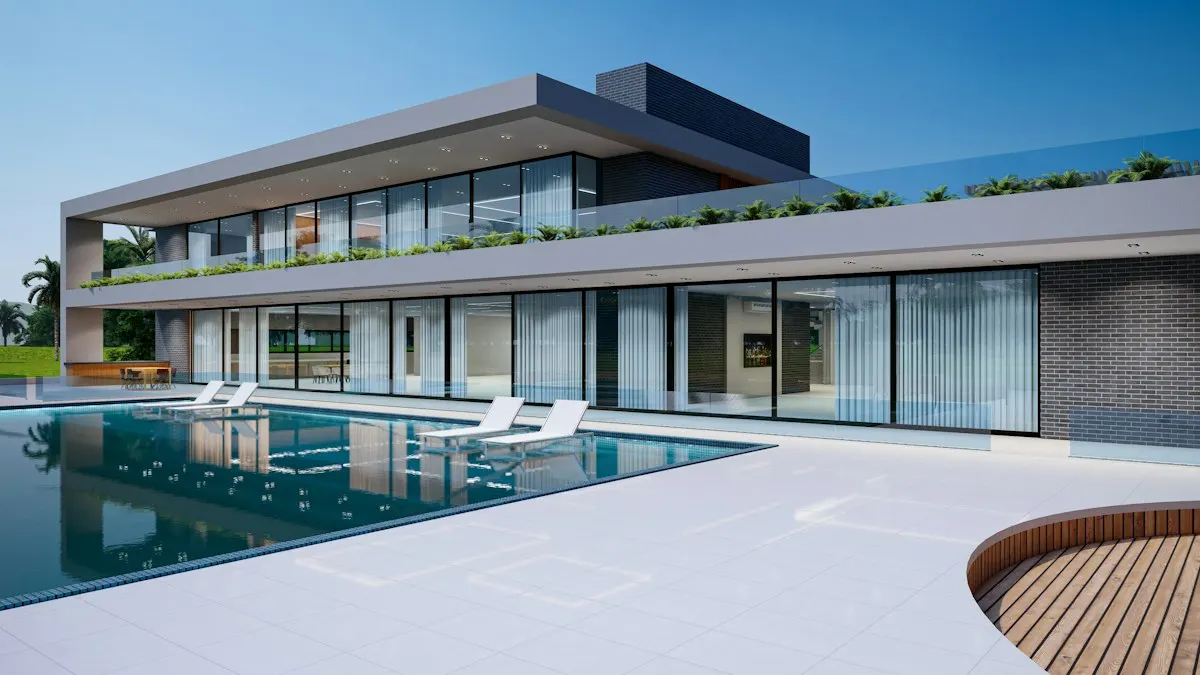
Photo: Salman Saqib · License.
This is the decision most pool buyers face first, and it shapes everything after it: the timeline, the finish, the equipment, even which builders you invite. HomeAdvisor's 2026 table puts gunite at $65,000–$120,000 installed, well above fiberglass. That gap is real, but it narrows once long-run costs and site conditions are counted.
The comparison table on the comparison tool summarizes the trade-off in eight rows. This page works through real scenarios, the twenty-year cost picture, climate, resale and the mistakes that make either shell disappointing. It also explains how to put a gunite bid and a fiberglass bid on the same footing, which is harder than it sounds because the two are often quoted with different scopes.
Gunite is a custom concrete shell built in place over months, with any shape and an integrated spa, and an interior that is resurfaced every 10 to 15 years. Fiberglass is a factory shell set in weeks, with a smooth, low-chemical surface and shapes limited to the manufacturer's molds and the crane's reach.
| Factor | Gunite (concrete) pool | Fiberglass pool |
|---|---|---|
| Upfront cost | $65,000 to $120,000 installed (HomeAdvisor 2026); $50,000 to $120,000+ (Thursday Pools 2026) | $25,000 to $60,000 (HomeAdvisor 2026); about $74,000 to $113,000 by size (Thursday Pools 2026); $60,000 to $100,000 basic install (River Pools) |
| Lifespan and recurring cost | Shell lasts decades; resurfacing every 10 to 15 years at $10,000 to $20,000 (River Pools) | Shell lasts decades; gelcoat rarely refinished; no liner |
| Maintenance | Plaster is porous and alkaline; more brushing, acid and algae attention | Smooth non-porous surface; lower chemical use and less brushing |
| Appearance and shape | Any shape, depth, ledge, beach entry, raised spa or infinity edge | Manufacturer molds; typical max about 16 by 40 ft; built-in steps and benches |
| Climate fit | Works in all climates; freeze-thaw stresses plaster and tile line | Flexes with freeze-thaw; common in Northern markets |
| Install time | 3 to 6+ months (River Pools); 8 to 12 weeks after excavation (Today's Homeowner) | 2 to 6+ weeks (River Pools); 3 to 4 weeks after excavation (Today's Homeowner) |
| Resale / ROI | Any pool in good condition adds 5 to 8% nationally (Opendoor 2026) | Same; buyers rarely distinguish shell type in listing data |
| Best for | Custom shapes, integrated spas, sloped lots, owners who accept resurfacing cycles | Fast installs, low maintenance, standard shapes, yards a crane can reach |
Gunite wins when the design needs something a mold cannot give: a 45-foot lap lane, a raised spillover spa, a beach entry, a vanishing edge over a slope. It also wins when crane access is impossible and when the owner is comfortable budgeting River Pools' $10,000 to $20,000 resurfacing every 10 to 15 years. On a difficult site the design and build page explains why concrete is often the only option.
Fiberglass wins when the family wants to swim this season, when the yard has a clear crane path, when a standard rectangle or freeform from the catalog fits the plan, and when lower chemical use and no resurfacing matter more than a custom shape. HomeAdvisor's price gap of roughly two to one in favor of fiberglass is real for the shell, though full packages from either type converge once decking, fencing and equipment are added.
A family with young children on a flat suburban lot, a wide side yard and a spring deadline usually lands on fiberglass. The molded tanning ledge, benches and steps suit their use, the install is quick, and the smooth surface is kind to small feet. The limits of the mold library rarely matter for a straightforward rectangle or freeform.
A sloped lot, a narrow city yard with no crane access, or a design with a raised spillover spa and a vanishing edge points to gunite. So does a pool larger than the biggest shells, commonly around 16 by 40 feet, or a depth profile no mold offers. For lap swimmers who want an exact length and uniform depth, gunite is often the only way to get precisely what they want.
Upfront, the two shells overlap more than most guides suggest. Thursday Pools, a fiberglass manufacturer, prices 2026 fiberglass installs at $74,000–$113,000 by shell size, against gunite at $50,000 to $120,000 or more in the same guide. Over twenty years, gunite adds at least one resurfacing, which River Pools prices at $10,000 to $20,000 every 10 to 15 years, and fiberglass adds little beyond normal equipment replacement.
Chemical and cleaning costs also tilt toward fiberglass, because plaster is porous and alkaline, which raises acid demand and gives algae a foothold. Equipment costs are similar for both. Upkeep weighs on owners: HomeAdvisor puts annual pool maintenance at $960–$1,800 per year, including pump electricity of up to $300. The honest summary is that fiberglass is usually cheaper over twenty years for a pool of the same size, but gunite buys design freedom that some yards and owners need. Use the calculator to compare your size.
Thursday's side-by-side comparison puts ten-year upkeep at $20,000+ vs $5,750 for gunite against fiberglass. That is a seller's estimate, and the same article sets both shells at $45,000 to $65,000 upfront, below its own size-based cost guide, so use it for the maintenance gap rather than the build price. River Pools, also a fiberglass builder, gives 2–6 weeks vs 3–6 months for the build. The table in this section lists both sources' figures.
| Factor | Gunite | Fiberglass | Source |
|---|---|---|---|
| Ten-year maintenance | About $20,000 or more | About $5,750 | Thursday Pools (fiberglass maker) |
| Weekly upkeep time | 4 to 5 hours | An hour or less | Thursday Pools |
| Install time | 3 to 6 months | 3 to 6 weeks | Thursday Pools; River Pools gives 3 to 6+ months vs 2 to 6+ weeks |
| Size limit | None set by a mold | About 16 ft wide and 40 ft long at most | Thursday Pools |
| Salt system | Salt gradually wears the cement finish | No finish concern raised | Thursday Pools |
| Interior renewal | Resurface every 10 to 15 years at $10,000 to $20,000 | Not required | River Pools |
Both shells work in every U.S. climate when properly installed. Fiberglass flexes slightly with freeze-thaw and is common in northern markets, where a short building season also rewards a fast install. Our analysis of EIA's 2024 household survey found 94.88% of Northeastern pool homes use the pool one to six months, against 41.9% nationally. Gunite is rigid and strong, but freeze cycles stress the plaster and the waterline tile, so bond beam detailing and winterization matter more. In hot climates, both perform well.
Soil and groundwater matter more than air temperature. Expansive clay can push against any shell, and a high water table can float an empty pool. Fiberglass installations depend heavily on correct backfill and a hydrostatic relief plan. Gunite shells rely on steel and thickness. Either way, ask the builder how they handle your soil type and what the warranty says about structural movement.
Buyers value having a pool far more than they value the shell type. Opendoor estimates a pool adds 5–8% to home value nationally, more in the Sun Belt, and that owners typically recoup 40–60% of an inground pool's cost at resale. Neither figure depends on shell type, and listing data rarely distinguishes between them.
Condition matters more than material. A gunite pool with fresh plaster and a fiberglass pool with bright gelcoat both show well. A gunite pool due for resurfacing, or a fiberglass shell with faded or blistered gelcoat, will show up in inspection reports and negotiations. If you expect to sell within a decade, weight the choice toward the shell you can keep looking new with the least effort.
With fiberglass, regrets usually trace to installation: poor backfill that lets the shell shift, a shell set out of level, or a yard where the crane path damaged landscaping or utilities. Choosing a shell only because it was in stock, without checking it fits your use, is another common regret. Ask to see a shell in person before committing to a model.
With gunite, regrets usually involve the finish or the schedule. Low-grade plaster that etches quickly, poor startup chemistry, and tile lines that crack because of bond beam movement lead to early repairs. Long delays between stages can also frustrate owners. Ask each builder for a stage-by-stage schedule, the plaster or pebble product, and the startup procedure in writing.
Normalize the scope first. Make sure both bids include the same equipment, deck area, barrier, heater and cover, because one builder may include a surround the other omits. For gunite, confirm the steel schedule, shell thickness, interior finish and tile. For fiberglass, confirm the manufacturer, model, delivery, crane and backfill material. The design-build page lists what a complete proposal includes.
Then compare long-run costs, not only the contract total. Add a resurfacing cycle to the gunite bid if you plan to stay more than a decade; it is usually bundled with retiling, a recurring cost on top of the $65,000–$120,000 HomeAdvisor lists for a gunite build. Compare warranty terms for the structure and for the finish separately. The estimate request lets you ask for both shell types from builders who install each, which makes the comparison far easier.
Homeowner polls
No votes yet. Yours will be the first. · saved on this device
Drives size, depth, heating and whether a spa is the better project.
No votes yet. Yours will be the first. · saved on this device
No votes yet. Yours will be the first. · saved on this device
Ledges and benches are molded into many models, and manufacturers offer attached fiberglass spas and spillover options. What you cannot get is a ledge at a custom depth or a spa at a custom height; you choose from the catalog. If the exact configuration matters, gunite.
Usually fiberglass, because it avoids one or two resurfacing cycles and uses fewer chemicals, though the source for that comparison is often a fiberglass builder. A gunite pool with a pebble finish that lasts 20 years narrows the gap. Run both through the calculator and add the resurfacing line to gunite.
Older gelcoats did; modern shells with UV-stable gelcoat hold color well for decades, and manufacturers warrant the surface. Water chemistry matters: sustained low pH or high metals stain any surface. Ask the builder for the shell manufacturer's surface warranty terms in writing.
Yes, with extra site work. The shell must sit on a level, compacted base, so a sloped lot usually needs retaining walls or a partially raised design, and the exposed side may need a structural wall or veneer. The added cost can erase much of fiberglass's upfront advantage. Gunite handles slopes more naturally because the shell itself can act as a retaining structure.
Gunite usually wins for serious lap swimmers because it can be built to any length and a uniform depth. Some manufacturers make narrow lap-style fiberglass shells, but lengths are limited by transport. If you want a specific length, lane markings or a turn wall, gunite offers the most control. For casual exercise, a long fiberglass shell may be enough.
Fiberglass manufacturers often offer long structural warranties on the shell and shorter warranties on the gelcoat surface. Gunite builders typically warrant the structure and give a separate, shorter warranty on plaster or pebble finishes. Read the exclusions carefully, especially for soil movement and water chemistry, because those clauses decide whether a claim is covered.
Often yes, as long as the ground is diggable and the site is accessible for the crane. Frozen ground, deep snow and wet conditions can delay excavation and backfill. Many northern builders set fiberglass pools late into fall or early in spring. Gunite work in cold weather needs care because concrete and plaster must cure above certain temperatures.
Fiberglass has a slight insulating advantage because the shell material conducts heat less than concrete, and its smooth surface loses little heat. In practice, a cover and heater matter far more than shell type for water temperature. If heating cost is a priority, invest in an automatic or solar cover before worrying about shell material.
Some companies offer fiberglass resurfacing systems for concrete pools, applying a fiberglass-reinforced coating over the old shell. That is different from a molded fiberglass pool and has its own costs and warranty terms. Replacing a gunite pool with a molded fiberglass shell means demolition and a new build. Ask a renovation specialist which option suits your pool's condition.
 ComparisonFiberglass pool vs Vinyl liner pool
Pick vinyl if the upfront budget is tight, you want a custom shape without gunite pricing, or your season is short.
 ComparisonIn-ground spa vs Portable hot tub
Choose an in-ground spa if you are building a pool and want the spa to share its equipment and double as a water feature.
 ComparisonPoured concrete deck vs Paver or travertine deck
Choose poured concrete for the lowest cost per square foot, large areas and a smooth continuous surface, knowing it will crack at some point and needs sealing.
 ComparisonSaltwater chlorine generator vs Traditional chlorine
Choose a salt chlorine generator if you swim in a warm climate over a long season, dislike buying and handling chlorine, and want softer-feeling water.
 ComparisonNatural gas heater vs Electric heat pump
Choose a gas heater if you need fast heat for a spa, swim mainly on weekends, or live where spring and fall air is cold.
 Service guideCustom Pool Design & Build
Custom pool design and build covers everything from the site plan to first swim: excavation, the shell in gunite, fiberglass or vinyl, equipment and plumbing, electrical and bonding, the barrier, startup and training.
 Service guideSpa & Hot Tub Installation
Spa and hot tub installation covers the base, the delivery route, the dedicated electrical circuit with GFCI protection, drainage around the unit, and the cover and access arrangement that make it usable every week.
 Service guideWater Features & Waterfalls
Water features add sound and motion to a pool through sheer descents, bubblers, deck jets, scuppers, spillover spas or rock waterfalls.
 Service guidePool Decking & Coping
Pool decking and coping form the transition from water to yard: the coping caps the bond beam and the deck carries foot traffic and sheds water.
 Free toolInground pool cost calculator
Size, material tier and complexity in, a realistic budget range out.
 Free toolPool planning quiz: nine things to know before the first site visit
9 questions that show what you already know and what to check next.
 Free toolPool planning polls
See what other planners chose and add your vote.
Tell us the size, the condition of what is there now, and what you want to change. Pool Plan Compass passes your request to independent local professionals, who reply with written, no-obligation estimates. The service is free to use.