Northeast
Short season, hard freeze: plan closing, drain-down plumbing, freeze-thaw deck materials and a winter cover. Consider a year-round hot tub; 42% of hot-tub homes here use it all twelve months. File permits in winter for a spring dig.
Loading...
Pool Plan Compass · Locations
Region decides how many months you will swim, whether the pool needs a heater, what the soil does to excavation, how the freeze affects the shell and deck, and when builders have capacity. EIA's 2024 survey shows Western pool homes swim year-round at four times the Northeastern rate. Plan the pool for your climate, not for a national average.
The same 16 by 32 pool costs different money, swims a different number of months and needs different equipment in Phoenix, Houston, Chicago and Boston. Today's Homeowner's 2026 state ranges put inground pools at $59,000–$140,000, with Florida and Texas in between, and those differences are labor, soil, permits and finish expectations rather than the shell.
EIA's 2024 Residential Energy Consumption Survey adds the use side: 76.89% of Western pool homes and 63.15% of Southern pool homes use the pool all twelve months, against 47.7% nationally, while the Northeast and Midwest are overwhelmingly seasonal. Those are installed-stock figures for existing pool owners, but they are the best available guide to what a new pool in your region will actually deliver.
Short season, hard freeze: plan closing, drain-down plumbing, freeze-thaw deck materials and a winter cover. Consider a year-round hot tub; 42% of hot-tub homes here use it all twelve months. File permits in winter for a spring dig.
Year-round use for most owners; high water tables in Florida need dewatering and hydrostatic relief, Texas clay needs joint detailing, and summer storms make deck drainage a design item. Heat pumps and screen enclosures are common.
Fewest pools and a 14-week season: vinyl or fiberglass are common for freeze tolerance and cost. Plumbing below frost depth or fully drained, expansion joints at the coping, and builders booked the previous fall.
Most heating and most variable-speed pumps; dry air makes a cover the top operating-cost measure. California costs run highest; desert decks need light, cool materials. Watch monsoon and fire seasons for scheduling.
EIA's 2024 survey found 94.88% of Northeastern pool homes use the pool one to six months, and 63.1% report an unheated pool against 60.06% nationally. Only 21.5% report a variable-speed pump, against 47.7% of pool homes nationwide and the lowest of any region, which reflects an older installed base. The pool season runs Memorial Day to Labor Day, and everything about the design should assume closing: a winter cover, freeze-protected plumbing with drain-down points, and a deck material that survives freeze-thaw.
The hot tub is the counterpoint. The same survey found 42.2% of Northeastern hot-tub homes use the tub all twelve months, the highest year-round rate in the country, though only 5.7% of the region's homes have a tub against 7.61% nationally. If the household's real goal is a place to soak in January, the spa page is the better plan and a tenth of the cost. Build season for pools is April through October; permits pulled in winter get you first in line.
The South has the most pools in absolute terms: EIA's survey found 8.6% of Southern homes have one, about 4.4 million, and 63% of those use it year-round. Realtor.com's 2025 data shows 61.8%, which means in those metros a home without a pool is the exception at resale. Opendoor puts the Sun Belt pool premium at 10 to 15% or more of home value.
The construction issues are water and rain. Florida's high water table can require dewatering during excavation and hydrostatic relief valves in the shell so an empty pool does not float. Texas clay swells and shrinks with moisture, which stresses decks and coping joints. Afternoon storms mean deck drainage is a design item. Heat pumps run efficiently here for most of the year, and a screen enclosure is a common barrier and debris solution in Florida.
EIA's survey found 4.4% of Midwestern homes have a pool, the lowest share of any region, and 89.2% of those use it one to six months, against 41.9% of pool homes nationally. That is not a reason not to build; it is a reason to build for a short, intense season and a long closed one. Vinyl liner and fiberglass are common here because both tolerate freeze better than plaster and cost less for a pool that swims fourteen weeks a year.
Frost depth of three to four feet means plumbing below the frost line or fully drained, and deck footings for any structure set accordingly. Expansion joints at the coping earn their keep every March. Builders work April to October and often book spring installs the previous fall. The fiberglass versus vinyl comparison is the relevant one for most Midwestern yards.
The West leads on equipment. EIA's survey found 49.6% of Western pool homes heat the pool, 27.7% with natural gas against 15.8% nationally, and 77% report a variable-speed pump, likely reflecting California's early efficiency rules. Pool use is year-round for 77% of pool homes, and 3.7% of Western homes have both a pool and a hot tub against 2.1% nationally. Today's Homeowner puts California inground pools at $59,000 to $140,000, the highest state range, driven by labor, permitting and seismic and soils engineering on hillside lots.
Dry air means evaporation is the main water loss, and a cover is the single most effective operating-cost measure. Water features cost more to run here for the same reason. Arizona's summer means deck material and color decide whether the pool is usable at 3 p.m. in July, which is why travertine and cool-deck finishes dominate. Monsoon season in the desert Southwest and fire season in California both affect scheduling.
In freeze regions the excavation window is April to October and the permit window is whenever you file, so file in January. In the Sun Belt construction runs year-round, and the competition for crews is worst in spring when everyone wants to swim by June. Pool Corporation noted on its Q4 2025 call that Florida will soon be its largest installed-base market, which tells you where the crews are and where they are busiest.
PHTA's Q3 2025 Pulse Survey found 44% vs 37% on new-pool revenue, a modest positive tilt, with 69% of firms expecting growth. In practice that means a homeowner with a clear brief and off-peak timing gets attention. Use the estimate request in the shoulder season for your region and the calculator to adjust for local labor before you compare.
| Region | Pool homes (EIA 2024) | Use pool 12 months | Report heating | Variable-speed pump |
|---|---|---|---|---|
| Northeast | 7.2% | Minority; 95% use 1 to 6 months | 32% | 21% |
| South | 8.6% | 63% | 32% | 47% |
| Midwest | 4.4% | Minority; 89% use 1 to 6 months | 36% national ref. | 38% |
| West | 7.6% | 77% | 50% | 77% |
Homes with a swimming pool: 7.2% nationally. Highest in Florida (19.9%), Arizona (18.9%), Nevada (11.8%); lowest in Maryland (3%), Illinois (3.5%), Hawaii (3.6%).
Homes with a hot tub: 7.6% nationally. Highest in Washington (12.6%), Nevada (12.3%), Montana (12.2%); lowest in Kentucky (3.5%), Massachusetts (4.1%), New York (4.9%).
Pool Plan Compass calculated these state estimates from the Energy Information Administration's 2024 household survey microdata. EIA publishes the 2024 survey nationally and by region, not by state. Shares are weighted; a dash means the state sample was too small for a reliable estimate (fewer than 100 households, fewer than 10 yes answers, or a relative standard error above 30%). Source data.
| State | Homes with a swimming pool | Homes with a hot tub |
|---|---|---|
| United States | 7.2% | 7.6% |
| Alabama | 5% | 5.7% |
| Alaska | — | 11% |
| Arizona | 18.9% | 11.8% |
| Arkansas | — | — |
| California | 9.8% | 10.8% |
| Colorado | — | 7.1% |
| Connecticut | 9.8% | 5.9% |
| Delaware | — | 9.1% |
| District of Columbia | — | — |
| Florida | 19.9% | 10% |
| Georgia | 6% | 5.8% |
| Hawaii | 3.6% | — |
| Idaho | — | 9.4% |
| Illinois | 3.5% | 9% |
| Indiana | 5.6% | 5.9% |
| Iowa | — | 5.7% |
| Kansas | — | 7.1% |
| Kentucky | 9.4% | 3.5% |
| Louisiana | 9.5% | 6.5% |
| Maine | 5.1% | 5.6% |
| Maryland | 3% | 8.6% |
| Massachusetts | 5.8% | 4.1% |
| Michigan | 5.2% | 6.5% |
| Minnesota | — | 8.7% |
| Mississippi | 5.3% | 6.5% |
| Missouri | — | 6% |
| Montana | — | 12.2% |
| Nebraska | — | 6.3% |
| Nevada | 11.8% | 12.3% |
| New Hampshire | 8.3% | 7.1% |
| New Jersey | 8.4% | 7.9% |
| New Mexico | — | 6.5% |
| New York | 7.2% | 4.9% |
| North Carolina | 4.7% | 5.5% |
| North Dakota | — | 8.2% |
| Ohio | 7.6% | 6.7% |
| Oklahoma | 7.3% | 8.6% |
| Oregon | — | 9.9% |
| Pennsylvania | 6.2% | 5.8% |
| Rhode Island | 8.7% | 5.8% |
| South Carolina | 7.4% | 8.2% |
| South Dakota | — | 8.6% |
| Tennessee | 6.8% | 6.9% |
| Texas | 8.1% | 7.1% |
| Utah | — | 11.7% |
| Vermont | 8% | — |
| Virginia | — | 5.8% |
| Washington | — | 12.6% |
| West Virginia | — | — |
| Wisconsin | — | — |
| Wyoming | — | 9% |
Homeowner polls
EIA's 2024 survey found 77% of Western pool homes swim year-round versus a small minority in the Northeast.
No votes yet. Yours will be the first. · saved on this device
EIA's 2024 survey found 60% of U.S. pool homes report an unheated pool.
No votes yet. Yours will be the first. · saved on this device
Rarely, because frozen ground cannot be excavated efficiently and concrete cannot cure properly below freezing without expensive measures. What you can do in winter is design, engineering, HOA approval and the permit, so the dig starts the first week the ground thaws. Fiberglass shells can sometimes be set in late fall and finished in spring.
Many do not, and EIA's 2024 survey found 65% of Southern pool homes report an unheated pool. A heat pump extends the season by two months at each end for modest cost in humid climates, and is worth it if you want to swim in March and November. In the desert West the water can be too warm in August, and some owners run a heat pump in reverse as a chiller.
No. Fiberglass flexes slightly and tolerates freeze-thaw well when properly backfilled and winterized. The risks are the same as any pool: water left in lines, and a shell drained without hydrostatic relief in a high water table. Vinyl and fiberglass are both common in the Midwest and Northeast for this reason.
Labor rates, permit and inspection costs, seismic and soils engineering on hillside lots, and higher expectations for finishes. Today's Homeowner's 2026 range of $59,000 to $140,000 for California is roughly double Arizona's. Efficiency rules also mean variable-speed pumps and specific heater standards are required, which adds equipment cost but lowers operating cost.
A spring-loaded valve in the pool floor that opens when groundwater pressure under the shell exceeds the water pressure inside, so an empty or partly drained pool does not lift out of the ground. It matters in Florida and any site with a high water table, and it is why pools there should not be drained without a professional checking groundwater first.
Not by code, but it is common because it keeps out debris, insects and leaves, reduces evaporation and chemical use, and in many jurisdictions is accepted as part of the barrier when it has self-latching doors. It also affects heating: less sun reaches the water. Budget it as a separate line and confirm barrier acceptance with the county.
Cold nights even in summer mean a heater is close to mandatory, UV is stronger on finishes and covers, and freeze-thaw cycles are more frequent. Gas heaters lose capacity at altitude and should be sized accordingly. A shorter season and higher heating cost push many mountain owners toward a hot tub or swim spa rather than a full pool.
 Service guideCustom Pool Design & Build
Custom pool design and build covers everything from the site plan to first swim: excavation, the shell in gunite, fiberglass or vinyl, equipment and plumbing, electrical and bonding, the barrier, startup and training.
 Service guideSpa & Hot Tub Installation
Spa and hot tub installation covers the base, the delivery route, the dedicated electrical circuit with GFCI protection, drainage around the unit, and the cover and access arrangement that make it usable every week.
 Service guideWater Features & Waterfalls
Water features add sound and motion to a pool through sheer descents, bubblers, deck jets, scuppers, spillover spas or rock waterfalls.
 Service guidePool Decking & Coping
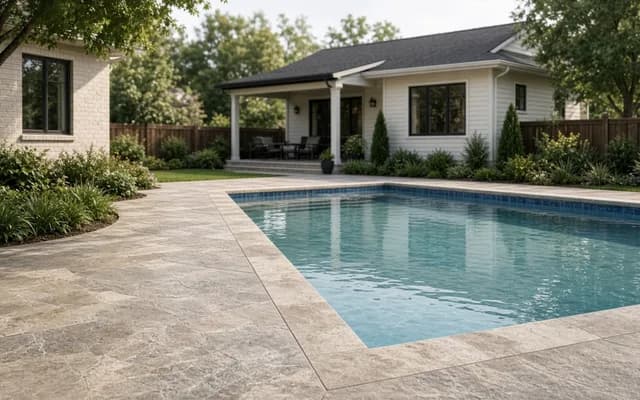
Pool decking and coping form the transition from water to yard: the coping caps the bond beam and the deck carries foot traffic and sheds water.
Tell us the size, the condition of what is there now, and what you want to change. Pool Plan Compass passes your request to independent local professionals, who reply with written, no-obligation estimates. The service is free to use.