Which deck material are you planning?
No votes yet. Yours will be the first. · saved on this device
Loading...
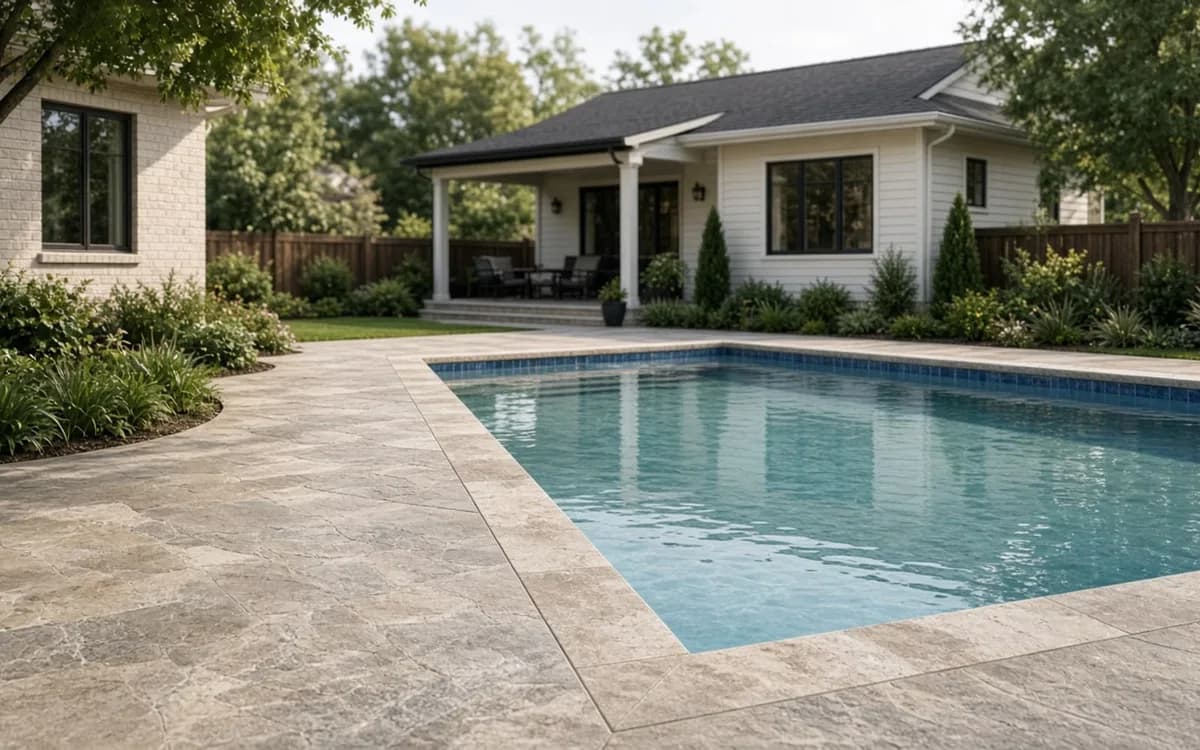
Pool Plan Compass · Service guide
Pool decking and coping form the transition from water to yard: the coping caps the bond beam and the deck carries foot traffic and sheds water. The service covers material selection, the expansion joint between deck and shell, drainage, surface texture and heat, and how the new surface meets existing patios and lawn. It suits new pools and older pools whose edge is chipped or whose deck ponds.
The deck is where you spend most of your pool time and where a bad decision shows first. A dark stamped concrete deck in Phoenix is unwalkable barefoot by noon; a deck poured hard against the coping with no joint cracks the tile line in two winters; a deck that slopes toward the house sends chlorinated water at the foundation. Concrete Network prices concrete pool decks at $6–$18+ per sq ft, which for a 900 square foot surround is $5,400 to $16,200.
River Pools' 2025 guide separates patio from the pool package because material choice can swing the cost by three to five times: $10–$50+ per sq ft from basic concrete to luxury stone. This page covers the materials, the coping types that cap the beam, the joint and drainage details that decide whether the deck lasts, and how to compare a hardscape proposal with a pool builder's allowance. The design and build page shows where the deck fits in the whole scope.
Want the numbers only? Read the pool decking & coping cost guide for 2026 ranges, what moves the price, and sample budgets.
| Item | Low | High | Unit | Notes |
|---|---|---|---|---|
| Broom-finish concrete deck | $6 | $11 | per sq ft | Concrete Network 2026 |
| Stamped or stained concrete | $11 | $18 | per sq ft | |
| Concrete pavers | $12 | $25 | per sq ft | Includes base and edge restraint |
| Travertine pavers | $15 | $35 | per sq ft | |
| Natural stone | $20 | $45 | per sq ft | Concrete Network stone range |
| Precast or stone coping | $30 | $60 | per linear ft | Set in mortar on bond beam |
| Expansion joint and sealant | $8 | $15 | per linear ft | |
| Deck drain channel | $20 | $45 | per linear ft |
Broom-finish concrete is the baseline at Concrete Network's $6 to $11 per square foot, with stamped or stained at $11 to $18 and elaborate work above $18. It is monolithic, easy to slope and the cheapest to expand later. Its weaknesses are heat under a dark color, slipperiness with a smooth finish, and cracking if control joints are skipped. A textured topcoat, often sold as a cool deck, lowers surface temperature and adds grip for a few dollars more.
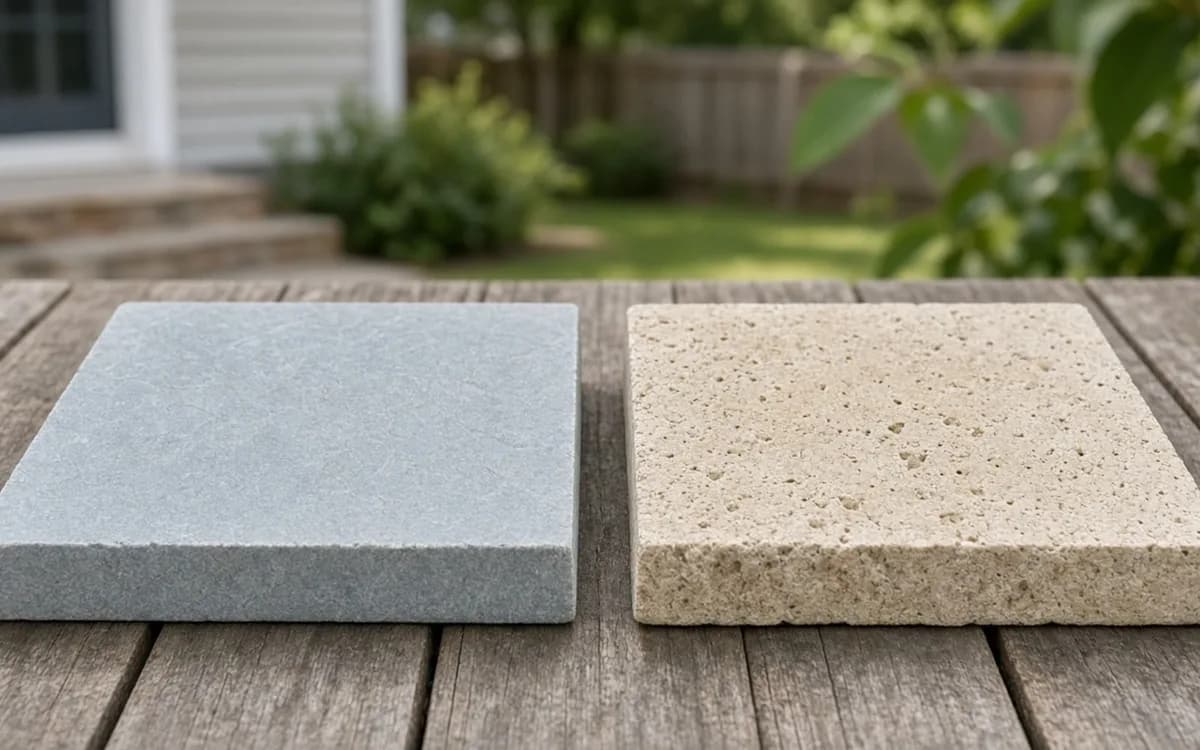
Pavers and travertine are set on a compacted base and can be lifted and reset if a line breaks or the base settles, which concrete cannot. Concrete Network puts stone pavers at $12 to $45 per square foot installed. Travertine stays notably cooler than concrete and drains through its joints, which is why it dominates Sun Belt pool decks. Its cost is the base preparation, the edge restraint and the fact that pavers next to a pool must be sealed against chlorine and calcium.
| Deck material | Installed per sq ft | Heat underfoot | Repairability |
|---|---|---|---|
| Broom-finish concrete | $6 to $11 | Hot in dark colors | Patch only |
| Stamped / stained concrete | $11 to $18 | Hot unless light color | Patch, hard to match |
| Cool-deck textured overlay | $8 to $15 | Cooler | Recoat |
| Concrete pavers | $12 to $25 | Moderate | Lift and reset |
| Travertine | $15 to $35 | Cool | Lift and reset |
| Natural stone / flagstone | $20 to $45+ | Varies | Reset, costly |
Coping is the cap on the bond beam, the top edge of the shell that the tile line sits under and the deck butts against. It gives swimmers a grip, keeps deck water from running into the pool, and hides the joint between shell and deck. Options run from cantilevered poured concrete that extends the deck over the edge, to precast concrete in bullnose profiles, to cut travertine, limestone or granite in flat, bullnose or drop-face shapes.
Cantilever coping is cheapest and reads as one surface with a concrete deck, but it cracks with the deck and cannot be replaced piecemeal. Precast and stone coping are set in mortar on the beam and can be individually replaced. Fiberglass pools use a cantilever form or a coping stone set on a concrete collar. Whatever you choose, ask for a mock-up of the corner detail, because the edge radius is where cheap coping looks cheap.
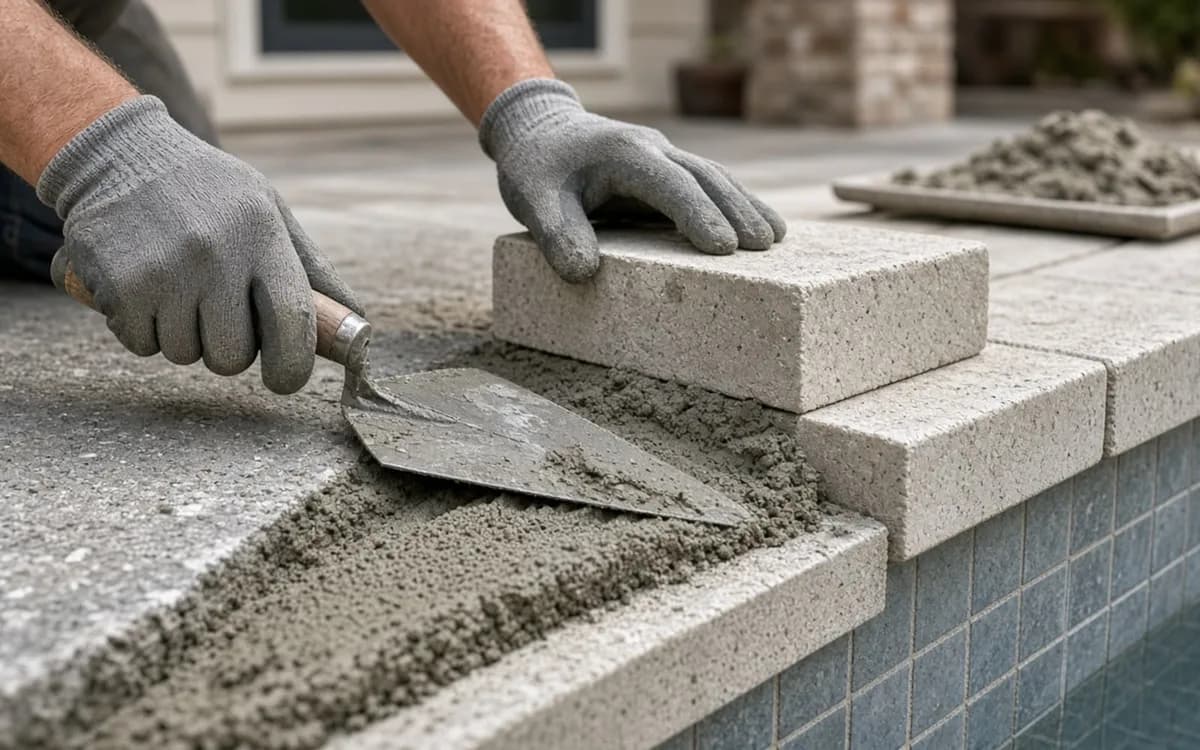
The shell and the deck move differently: the shell is a stiff bowl, the deck is a slab on soil that heaves, shrinks and settles. If the deck is poured hard against the coping, the first cold winter or hot summer pushes the deck into the beam and cracks tile, coping or both. The fix is an expansion joint, typically a half-inch foam backer between the coping and the deck filled with a flexible sealant that is replaced every few years.
Mastic that has hardened or pulled away is the single most common defect on pool decks more than five years old, and it is the root of most tile-line failures. Ask the pro you hire what joint material is specified, how wide it is, and who resets it. On paver decks the joint is the sand or polymeric joint itself, but the coping must still be separated from the paver base with a bond break. Concrete Network prices concrete pool decks at $6–$18+ per sq ft, or $5,400 to $16,200 for 900 sq ft; by comparison, resealing this joint is the cheapest repair there is.
A pool deck should fall away from the pool at roughly a quarter inch per foot for the first few feet, then continue to a drain, a lawn edge or a deck drain channel, and never toward the house. Splash-out, rain and hose water carry chlorine and calcium, and a deck that sends them at the foundation or into a planting bed will show it in efflorescence and dead shrubs within a season. Where the yard falls toward the pool, a trench drain along the deck's outer edge is standard.
On paver decks, water drains through the joints into the base, which is fine on a free-draining gravel base and a problem on clay. Ask how the base drains and where it discharges. Equipment pads deserve the same question: a heater sitting in a puddle rusts from the bottom. EIA's 2024 survey found 8.6% of Southern homes have a pool, and the South's summer rain is why deck drainage there is a design item, not an afterthought.
Surface temperature is a function of color, material and texture. A dark gray stamped concrete deck in full sun can exceed 140 degrees Fahrenheit, which burns feet in seconds. Light broom-finish concrete runs considerably cooler, textured cool-deck overlays cooler still, and travertine and light pavers coolest of the common options. Shade from a pergola or umbrella over the seating zone does more than any material.
In the Sun Belt, where Realtor.com's 2025 data shows 61.8% of listings with a pool, deck heat is the first question a buyer asks in July. Choose light colors, a textured finish for grip when wet, and a material you can hose down without leaving mineral streaks. The regional notes cover which materials hold up in freeze-thaw versus hot-dry climates.
Coping goes on after the shell has cured and the tile line is set; the deck goes in after plumbing has been pressure-tested and the electrical bonding has passed inspection, because both run under the slab. A concrete deck is formed, poured and finished in a day or two and can take foot traffic in a few days and furniture in a week. A paver deck takes longer: base compaction, screeding, laying, edge restraint and joint sand, typically one to two weeks for a 900 square foot surround.
Sequencing matters for the yard too. The deck pour is when the last heavy equipment leaves, so grading, irrigation repair and lawn restoration follow. HomeAdvisor's overall timeline gives 2–6 weeks, and the deck typically falls in the last two to three weeks. If you plan to add a pergola or a feature wall, footings and conduit go in before the deck, not after.
Compare square footage first, because pool builders and hardscape contractors often draw the deck line differently. Then compare the base: four inches of compacted gravel under pavers, or wire mesh and fiber in concrete, or neither. Then the joint detail, the drainage plan and the sealer. A proposal that names a paver brand and thickness, a joint sand type, and an edge restraint is comparable; one that says '900 sq ft pavers' is an allowance. River Pools prices pool patios at $10–$50+ per sq ft, from basic concrete to luxury stone; trading travertine for broom concrete is a fair saving, while thinning the base is not.
HomeAdvisor puts annual pool maintenance at $960–$1,800 per year, and the deck joint is exactly the kind of item that belongs in that budget: a small recurring cost that prevents a large repair. Use the cost calculator to see how the deck material changes the total, then send a marked-up photo of the yard through the estimate request.
Homeowner polls
No votes yet. Yours will be the first. · saved on this device
No votes yet. Yours will be the first. · saved on this device
 Service guideCustom Pool Design & Build
Custom pool design and build covers everything from the site plan to first swim: excavation, the shell in gunite, fiberglass or vinyl, equipment and plumbing, electrical and bonding, the barrier, startup and training.
 Service guideWater Features & Waterfalls
Water features add sound and motion to a pool through sheer descents, bubblers, deck jets, scuppers, spillover spas or rock waterfalls.
 Service guideSpa & Hot Tub Installation
Spa and hot tub installation covers the base, the delivery route, the dedicated electrical circuit with GFCI protection, drainage around the unit, and the cover and access arrangement that make it usable every week.
A minimum of three to four feet of clear surface on all sides for safety and cleaning access, widening to 10 to 15 feet on the side where people sit and eat. Many codes require a walkway around the pool of a set width. A 15 by 30 pool with a 4-foot band on three sides and a 12-foot patio on the fourth comes to roughly 900 square feet, which is why cost guides use that number.
Often yes, if the slab is sound and there is room to raise the surface without burying the coping. Thin pavers or travertine are set in a mortar bed or on a thin base over the old slab, which saves demolition. The catch is height: the new surface must still sit below the coping so water does not run into the pool, and doors and steps must still work.
Bullnose has a rounded front edge and reads soft; drop-face, sometimes called a rebated edge, has a squared front that hangs down over the tile line and reads modern. Both work in stone or precast. Drop-face hides the top of the waterline tile and is popular on rectangular pools; bullnose is easier on knees and hands and is the traditional choice on freeform shapes.
Concrete benefits from a penetrating sealer every two to three years to resist chlorine, salt and staining. Travertine and natural stone near the water should be sealed against calcium and sunscreen, though some owners prefer the natural weathered look. Pavers with polymeric sand should be sealed to lock the joints. Ask which sealer, how often and whether it changes slip resistance.
Usually because there is no working expansion joint at the coping, so the slab pushes against the shell as it expands. Other causes are a poorly compacted subgrade, missing control joints, or tree roots. Cracks parallel to the pool a foot or two out are the joint problem; random cracks across the deck are base or joint spacing. A resurfacing overlay hides them; a saw-cut joint and sealant fixes the cause.
Light foot traffic in two to three days, furniture in about a week, and full strength at 28 days. Sealers usually go on after 28 days when the concrete has cured, and heavy items like a hot tub need the full cure. Pavers can take furniture as soon as the joint sand is set.
Salt water splash-out crystallizes as it dries and can pit soft stone and etch unsealed concrete over years. HomeAdvisor's guide says a saltwater pool averages $25,000 new, and its deck should be a dense material, sealed, and hosed regularly. Travertine is common with salt pools when sealed; soft limestone and some flagstones are poor choices.
Before. Plaster is the last step so the finish is not damaged by construction traffic, and the deck must be in place so the pool can be filled immediately after plastering. The sequence is coping and tile, deck, equipment and inspections, then plaster and fill in one day.
 Free toolInground pool cost calculator
Size, material tier and complexity in, a realistic budget range out.
 Free toolPool and spa comparisons, decided by your conditions
Side-by-side tables for the decisions that change the price most.
 Free toolPool planning quiz: nine things to know before the first site visit
9 questions that show what you already know and what to check next.
 Free toolPool planning polls
See what other planners chose and add your vote.
Tell us the size, the condition of what is there now, and what you want to change. Pool Plan Compass passes your request to independent local professionals, who reply with written, no-obligation estimates. The service is free to use.