What worries you most about building a pool?
No votes yet. Yours will be the first. · saved on this device
Loading...

Pool Plan Compass · Planning quiz
Nine multiple-choice questions test what you know about inground pool costs, build timelines, barrier and drowning data, pump energy, heating fuels and resale. Each answer is explained with a sourced figure from the same guides and surveys used across this site. Most people miss two or three; those are the questions to bring to the builder.
Start the quiz0 of 9 answered
A builder's first meeting goes better when the homeowner already knows the order of magnitude. Someone who knows Angi's 2026 benchmark is $65,909 does not waste the visit on sticker shock. Someone who knows HomeAdvisor's timeline of 2–6 weeks does not ask for a June swim in May. Someone who knows CPSC's drowning data asks about the barrier before the tile.
The questions below are the ones estimators wish clients had read. Take it, read the explanations for the ones you missed, and then look at the comparisons or the calculator for the decision behind each one.
Three questions on cost: the national benchmark, the shell price spread and the extras owners typically add. Two on timeline: permits and the fiberglass-versus-gunite build clock. Two on safety and energy: CPSC's child drowning count and the effect of a variable-speed pump. Two on ownership: how many U.S. homes have a pool, which our analysis of EIA's 2024 survey puts at 7.25%, and what share of cost comes back at resale. Every explanation names the source and the year.
None of the questions is a trick, and none has a locally variable answer. Setbacks, permit fees and frost depth differ by city and are not quizzed. What is quizzed is the national picture that every proposal is built on top of.
A miss on the cost questions means the calculator is the next stop. A miss on timeline means read the regional notes and plan the permit date. A miss on the safety question means the barrier line belongs in your estimate request. A miss on the pump question means ask every builder for the pump model and its programmed schedule. The score is a to-do list, not a grade.
Pool Corporation estimated 61,000 new U.S. pools in 2024; the homeowners behind those pools who did the reading beforehand are the ones whose proposals had no allowances. Take the polls afterward to see what other planners found hardest.
The pump question and the extras question. Most people guess a variable-speed pump saves 25 to 50%, not the up-to-90% Pentair cites, and most underestimate what River Pools says owners add beyond the pool package. Both misses point the same way: the operating bill and the surround are where budgets go wrong, not the shell. ENERGY STAR's note that a pump can cost up to $310 per year a year to run is the figure to carry into the equipment discussion.
The safety question is missed in the other direction: people guess higher than CPSC's count, which is still 376 per year among children. Knowing the real figure, and that over 70% of those deaths happen at a residence, makes the barrier a first-meeting question rather than a final-inspection surprise. The design and build page covers what the barrier line should contain.
Anything that varies by city or by yard. Setback distances, permit fees, frost depth, HOA rules, soil type and whether a crane can reach your hole are all real questions with no single answer, so they are not quizzed. They are covered on the regional page and in the site-visit conversation with the pros you are matched with. Finish selections are also left out; tile color is a showroom decision, not a planning fact.
What is in the quiz is the national frame every proposal sits inside. Spa-only planners should know one more national fact: by our analysis of the same survey, 69.1% of hot-tub homes report no pool at all. Knowing the frame does not make you a builder, but it does make you a client who notices when a proposal has left the barrier, the pump model or the deck square footage as an allowance.
Homeowner polls
No votes yet. Yours will be the first. · saved on this device
No votes yet. Yours will be the first. · saved on this device
No, but it helps. The questions cover the facts a builder assumes you know, and the explanations point to the page where each decision is made. Homeowners who take it tend to send a more complete brief and receive proposals with fewer allowances.
The quiz uses national figures that do not vary by city: cost guide averages, federal survey shares, CPSC counts. Local items like permit fees, setbacks and frost depth are excluded because there is no single right answer. The locations page covers regional differences.
Because they publish the clearest timeline comparisons. River Pools builds fiberglass, and the quiz says so, pairing its figure with Today's Homeowner's independent timeline. Knowing who published a number is part of reading it.
Check the source link on the stat and read the original. Cost guides update and figures change; if the source has moved, use the contact page to flag it with the page and figure. Corrections are made against sources.
About five minutes for nine questions. Reading the explanations for the ones you missed takes another five. The follow-up reading on the comparison and calculator pages is where the time is well spent.
Yes, as often as you like. Scores are not stored. The value is in the explanations, which are the same each time, and in noticing which decisions you still have not made.
The safety, energy and resale questions apply to spas as well. Spa-specific facts, such as pad loads, circuit sizes and delivery routes, are covered on the spa and hot tub page rather than quizzed, because they depend on the unit you choose.
 Free toolInground pool cost calculator
Size, material tier and complexity in, a realistic budget range out.
 Free toolPool and spa comparisons, decided by your conditions
Side-by-side tables for the decisions that change the price most.
 Free toolPool planning polls
See what other planners chose and add your vote.
 Service guideCustom Pool Design & Build
Custom pool design and build covers everything from the site plan to first swim: excavation, the shell in gunite, fiberglass or vinyl, equipment and plumbing, electrical and bonding, the barrier, startup and training.
 Service guideSpa & Hot Tub Installation
Spa and hot tub installation covers the base, the delivery route, the dedicated electrical circuit with GFCI protection, drainage around the unit, and the cover and access arrangement that make it usable every week.
 Service guideWater Features & Waterfalls
Water features add sound and motion to a pool through sheer descents, bubblers, deck jets, scuppers, spillover spas or rock waterfalls.
 Service guidePool Decking & Coping
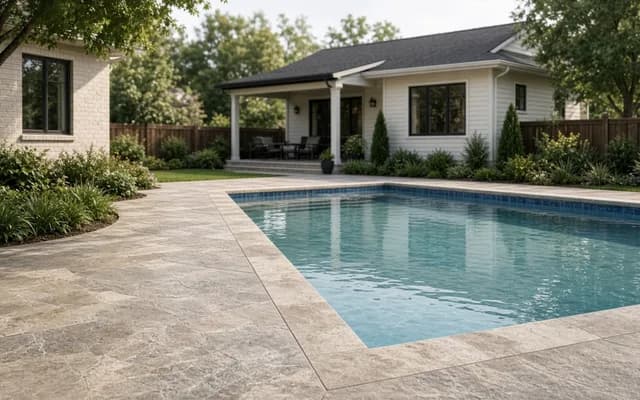
Pool decking and coping form the transition from water to yard: the coping caps the bond beam and the deck carries foot traffic and sheds water.
Tell us the size, the condition of what is there now, and what you want to change. Pool Plan Compass passes your request to independent local professionals, who reply with written, no-obligation estimates. The service is free to use.