What is the primary use for the water?
Drives size, depth, heating and whether a spa is the better project.
No votes yet. Yours will be the first. · saved on this device
Loading...
Pool Plan Compass · Free tools
Four tools cover the planning sequence: a cost calculator that scales Angi and HomeAdvisor benchmarks by size, shell and site complexity; comparison pages that weigh gunite against fiberglass, salt against chlorine and more; a quiz that tests what you know before you talk to a builder; and polls that show what other planners chose. Use them in that order.
 Free toolInground pool cost calculator
Size, material tier and complexity in, a realistic budget range out.
 Free toolPool and spa comparisons, decided by your conditions
Side-by-side tables for the decisions that change the price most.
 Free toolPool planning quiz: nine things to know before the first site visit
9 questions that show what you already know and what to check next.
 Free toolPool planning polls
See what other planners chose and add your vote.
By the numbers
$65,909
Typical U.S. inground pool costs $65,909, with most projects $44,499 to $87,349
Angi's cost guide, updated August 2026, is the benchmark behind this site's calculator. It is an inground pool reference, not a spa-only or water-feature price, and decking, barriers, excavation assumptions and landscaping must be confirmed in the proposal.
Angi, How Much Does It Cost to Install a Pool (2026)2–6 weeks vs 3–6 months
Fiberglass pools install in 2–6+ weeks; concrete pools take 3–6+ months
River Pools' 2025 cost guide contrasts the factory-built fiberglass shell with the multi-stage shotcrete, cure, plaster process of concrete. Timeline is often a deciding factor for families who want to swim the same season.
River Pools and Spas, How Much Do Inground Pools Cost in 2025 (2025)376 per year
376 children under 15 drowned in pools or spas each year from 2021 to 2023
CPSC's June 2026 report counted 379 fatal child drownings in 2023, up 6% from 359 in 2022, with nearly 80% of victims under age five and over 70% occurring in residential settings. Layered barriers, alarms and covers should be in the build plan from day one.
U.S. Consumer Product Safety Commission, 2026 drowning report release (2026)5–8%
A pool adds about 5–8% to home value nationally, 10–15%+ in the Sun Belt
Opendoor's May 2026 analysis, citing Zillow data, puts the isolated national pool premium at 5–8% (about $20,000–$32,000 on a $400,000 home), rising to 10–15% or more in Florida, Arizona, Texas, California and Nevada. Expect only partial cost recovery outside warm climates.
Opendoor, Does a Pool Add Value to Your Home (2026)Every tool on this site uses the same sourced figures that appear in the articles, so the calculator's output, the comparison table and the quiz answers agree with each other and with the page you read them on. None of them replaces a site visit and a written proposal. All of them make the proposal easier to read when it arrives.
Start with the calculator to see whether the project is a $50,000 conversation or a $120,000 one. Move to the comparisons to settle the shell and equipment questions. Take the quiz to find the decisions you have not made. Check the polls to see what other homeowners prioritized, then send the estimate request.
The calculator starts from a per-square-foot rate anchored to Angi's 2026 benchmark of $65,909 for a typical inground pool and HomeAdvisor's $50 to $125 per square foot range. You choose the pool's surface area, the shell type and the site complexity, then toggle add-ons such as an attached spa, a heater, an automatic cover, a barrier fence, a salt system and lighting. It returns a range, not a price.
It leaves out what no calculator can know: rock under your lawn, a crane over your roof, a 200-foot electrical run, an HOA fence rule, or a finish upgrade chosen at the tile showroom. Treat the output as the number to sanity-check proposals against. If a proposal is far above it, ask which line explains the gap; if far below, ask what was left out.
Each comparison takes two options that homeowners actually choose between and lines them up on upfront cost, lifespan, maintenance, appearance, climate fit, install time, resale and who each suits. Gunite versus fiberglass is the big one; River Pools contrasts 2–6 weeks vs 3–6 months, and HomeAdvisor prices them at very different levels. Salt versus chlorine, in-ground spa versus portable, concrete versus paver decks and gas versus heat-pump heating round out the set.
Read the verdict paragraphs for the conditions under which each option wins, because none of these is a universal answer. A fiberglass shell is faster, and it is also unavailable if the crane cannot reach the hole. The comparisons say so.
Nine questions on cost, timeline, barrier rules, energy and resale, each with an explanation tied to a sourced figure. A homeowner who knows that CPSC counted 376 per year asks about the barrier plan in the first meeting. One who knows that Opendoor puts the resale premium at 5–8% nationally does not overbuild for a listing photo. The quiz takes five minutes and produces better questions.
It also flags decisions you have not made: heating fuel (by our analysis of EIA's 2024 survey, only 35.8% of existing pool homes report one), deck material, whether the spa is base scope. Those are the items that turn into allowances and change orders when they are left open at signing.
The polls collect what other homeowners on this site chose and worried about: primary use, shell type, heating plan, deck material, feature type and the thing they most regret. Their value is calibration: if most planners with your climate chose a heat pump, the question is worth asking. If most say their regret was skipping the cover, budget the cover.
Pool Corporation's estimate of just under 60,000 new pools in 2025 says the market is stable at about half its peak; the polls say what the people building those pools are prioritizing. The 2026 U.S. Houzz & Home Study adds context: 54% of surveyed homeowners renovated in 2025 and 50% plan to in 2026. Vote, then see the running results.
Homeowner polls
Drives size, depth, heating and whether a spa is the better project.
No votes yet. Yours will be the first. · saved on this device
Angi's 2026 benchmark for the pool alone is $44,499 to $87,349.
No votes yet. Yours will be the first. · saved on this device
National, anchored to Angi and HomeAdvisor benchmarks, with a complexity setting that approximates site difficulty. They are not adjusted for your city's labor rate or permit fees. Today's Homeowner's state ranges show California roughly double Arizona, so read the output as a national reference and expect the local spread in the proposals.
The result is shown on the page with its assumptions listed, and you can note the range in your estimate request so the responding pros know what you are expecting. There is no account or saved history; run it again with different settings to see how each choice moves the number.
Because there is not one. Each verdict describes the conditions under which each option wins: crane access, climate, months of use, budget, appetite for maintenance. A comparison that names a universal winner is selling something. The pages here are written to help you decide, not to decide for you.
Yes, you see which answers you got right and the explanation for each, with the source. It is not a readiness test with a pass mark; it is a way to surface the facts you did not know before you meet a builder. Most people miss two or three, usually on barrier rules and operating cost.
One vote per question per browser, tallied on the page. They are a sample of the homeowners planning on this site and are labeled that way; they are not weighted or presented as a survey of all pool owners. Use them to see what other planners are thinking, not as a statistic.
The calculator and comparisons are built for inground pools, spas, features and decking, and their cost anchors do not apply to above-ground pools, which cost a fraction and have different barrier rules. The quiz's safety and energy questions apply to any pool.
The calculator. Enter a 450 square foot pool, pick a shell, add a fence and a heater, and you will see a range that tells you whether the conversation is realistic for your budget. If it is, take the quiz next time; if it is not, look at the spa page, which is a fraction of the cost.
 Service guideCustom Pool Design & Build
Custom pool design and build covers everything from the site plan to first swim: excavation, the shell in gunite, fiberglass or vinyl, equipment and plumbing, electrical and bonding, the barrier, startup and training.
 Service guideSpa & Hot Tub Installation
Spa and hot tub installation covers the base, the delivery route, the dedicated electrical circuit with GFCI protection, drainage around the unit, and the cover and access arrangement that make it usable every week.
 Service guideWater Features & Waterfalls
Water features add sound and motion to a pool through sheer descents, bubblers, deck jets, scuppers, spillover spas or rock waterfalls.
 Service guidePool Decking & Coping
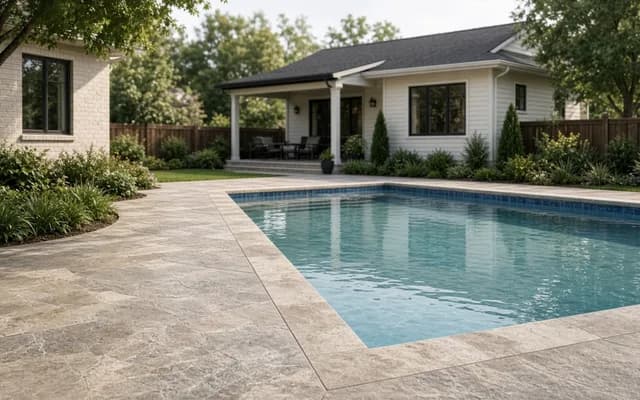
Pool decking and coping form the transition from water to yard: the coping caps the bond beam and the deck carries foot traffic and sheds water.
Tell us the size, the condition of what is there now, and what you want to change. Pool Plan Compass passes your request to independent local professionals, who reply with written, no-obligation estimates. The service is free to use.