Which deck material are you planning?
No votes yet. Yours will be the first. · saved on this device
Loading...
Pool Plan Compass · Pool Decking & Coping cost guide
Concrete Network prices concrete pool decks at $6 to $18 or more per square foot, while River Pools puts pool patios at $10 to $50 or more depending on material. Pavers, travertine and natural stone cost more than concrete. Coping, expansion joints and drainage are priced by the linear foot and add meaningfully to any deck budget.
The deck often covers more area than the pool itself, which makes it one of the largest line items in a pool project. Material choice, square footage and site conditions decide most of the cost. Coping and drainage add linear-foot costs that are easy to overlook. Getting those small items right does more for the deck's lifespan than the choice of surface material.
This guide shows how those pieces combine and where to save. The cost table and calculator on this page give per-item ranges. The decking and coping page explains materials and installation. Read it if you are still choosing a material, because this page assumes you know which surface you want and focuses on how the budget comes together from square footage, coping length, drainage and site preparation.
| Item | Low | High | Unit | Notes |
|---|---|---|---|---|
| Broom-finish concrete deck | $6 | $11 | per sq ft | Concrete Network 2026 |
| Stamped or stained concrete | $11 | $18 | per sq ft | |
| Concrete pavers | $12 | $25 | per sq ft | Includes base and edge restraint |
| Travertine pavers | $15 | $35 | per sq ft | |
| Natural stone | $20 | $45 | per sq ft | Concrete Network stone range |
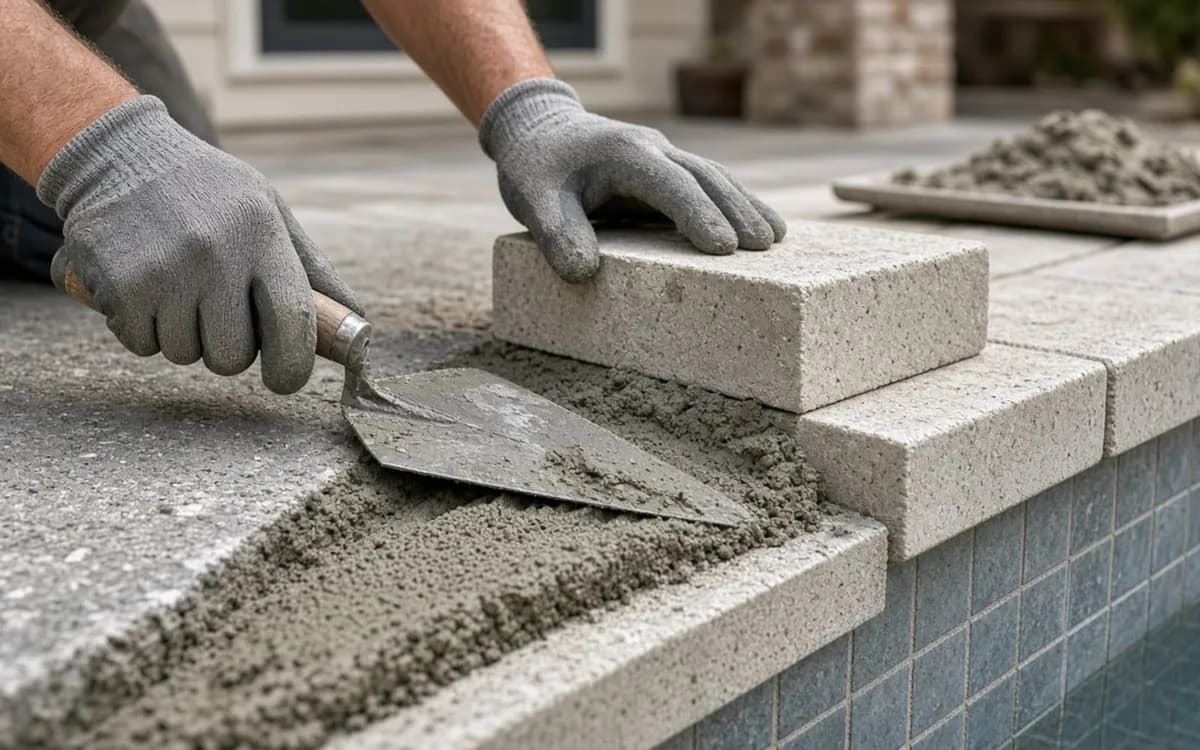
| Precast or stone coping | $30 | $60 | per linear ft | Set in mortar on bond beam |
| Expansion joint and sealant | $8 | $15 | per linear ft | |
| Deck drain channel | $20 | $45 | per linear ft |
Concrete Network puts concrete pool decks at $6–$18+ per sq ft, from broom finish at the low end to stamped and decorative concrete higher up. River Pools puts pool patios at $10–$50+ per sq ft, with basic concrete at the low end and luxury stone above. Pavers and travertine fall in between. Local material availability can shift these ranges noticeably.
Per-square-foot costs rise with complexity. Curves, steps, multiple levels and custom patterns add labor. Removing an old deck adds demolition and haul-off. Poor soil may need a deeper base. Always compare bids on the same square footage and material. Ask each contractor to measure the area and list it, so differences in price are not simply differences in size.
Coping is priced by the linear foot around the pool edge. Precast concrete, poured cantilever and natural stone coping differ in price and appearance. A pool with a long perimeter or a complex shape needs more coping. Raised walls and spas add more. Stone coping costs more than precast but can last longer and match a stone deck, so ask each contractor to list coping length and material as a separate line item.
Expansion joints between coping and deck, and drainage channels, are also priced by the linear foot. They are small line items but critical for preventing cracks and water damage. Skipping or skimping on them is one of the most common causes of deck failure. The concrete versus pavers comparison explains how each material handles drainage.
Concrete decks are labor-heavy in forming, pouring and finishing, but materials are relatively cheap. Paver decks have higher material costs and significant labor in base preparation and laying. Natural stone combines high material cost with skilled labor. Labor rates vary regionally, so the same deck can cost very different amounts in different markets.
Site access matters. A deck in a yard with easy truck access costs less to pour or deliver than one requiring wheelbarrows or pumps. Demolition of an existing deck adds labor and disposal costs. Ask each contractor to separate demolition, base preparation, material and finishing. That breakdown makes it easier to see whether a low bid is skimping on the base.
Decking usually follows the pool shell, plumbing, bonding inspection and coping. Delays in any of those push the deck back. Concrete decks need weather windows for pouring. Paver decks are less weather-sensitive. Building the deck with the pool usually costs less than building it separately later, since crews and equipment are already on site.
Time pressure can raise costs. Rushing a concrete pour in poor weather risks defects. Waiting for a specialty paver or stone delivery can delay completion. River Pools notes material choice can swing the surround cost by 3 to 5 times, and planning drainage and joints properly at the start protects whichever you pick.
Save by reducing square footage where it will not be used, using concrete for larger areas and pavers or stone only near the pool, and choosing simpler shapes and patterns. A broom-finish concrete deck can be upgraded later with an overlay or cool-deck coating. Phasing the deck is a reasonable way to spread the cost over two seasons. Concrete Network prices simple broom-finish decks at $6 to $11 per sq ft against $12 to $45 for stone pavers, and the deck surface is the right place for that trade.
Do not save on base preparation, drainage, joints or coping quality. These determine how long the deck lasts. A cheap deck that cracks and drains poorly will cost more in repairs. Use the calculator to test deck allowances and the estimate request to compare local prices. A contractor who explains base depth and joint spacing without being asked is usually worth a closer look.
A basic budget might use broom-finish concrete from Concrete Network's lower range across a modest area around the pool, with precast coping. A mid-range budget might use stamped concrete or concrete pavers with better coping and drainage. A premium budget might use travertine or natural stone throughout, with stone coping and extensive drainage.
Regional differences matter. In Sun Belt markets, where Realtor.com reports 61.8% of Miami listings have pools, travertine is common because it stays cool. In freeze climates, material choices focus on freeze-thaw durability. Season length sets the stakes: our analysis of EIA's 2024 survey found 47.7% of U.S. pool homes use the pool all year and 41.9% one to six months. The decking cost table shows the current ranges for each option. Local labor rates will shift every sample budget up or down.
By the numbers
Planning figures from published U.S. sources; every card links to where the number came from.
$6–$18+ per sq ft
Concrete pool decks cost $6–$18+ per sq ft, or $5,400–$16,200 for 900 sq ft
Concrete Network prices simple broom-finish decks at $6–$11, custom stamped or stained at $11–$18, and elaborate designs at $18+ per sq ft. Stone pavers run $12–$45 per sq ft installed by comparison.
Concrete Network, Concrete Pool Deck Cost (2026)$10–$50+ per sq ft
Pool patios run $10–$15 per sq ft for basic concrete, $20–$50+ for luxury stone
River Pools' 2025 guide separates patio from the pool package because material choice can swing the surround cost by 3–5x. Travertine, pavers and natural stone sit at the top of the range.
River Pools and Spas, How Much Do Inground Pools Cost in 2025 (2025)61.8%
In Miami 61.8% of listings have a pool; Phoenix 58.4%, Orlando 55.3%
Realtor.com's 2025 metro breakdown shows pools are the norm in Sun Belt markets. In these metros a home without a pool can be the outlier, which changes the resale math compared with northern markets.
Realtor.com / PR Newswire, Pool Premium report (2025)71%
of surveyed homeowners who hired a pro prioritized preventative maintenance
Angi's April 2025 pulse survey found preventative maintenance a top priority among homeowners who hired a professional. For pools that means deck joint sealant, cover care and pump scheduling.
Angi 2025 State of Home Spending Pulse Report (2025)The calculator uses the same pool and spa construction benchmarks as this guide. Set the size and tier, then request a written estimate to check it against a real proposal.
Homeowner polls
No votes yet. Yours will be the first. · saved on this device
No votes yet. Yours will be the first. · saved on this device
It depends on pool size, furniture, traffic and local codes. Many pools have decks that cover a similar or larger area than the water. Plan space for chairs, tables, walkways and any outdoor kitchen. A deck that is too narrow limits use; one that is too large adds cost without benefit.
Stamped concrete adds pattern and color at a moderate premium over broom finish. It can mimic stone or pavers at lower cost. It needs periodic resealing to maintain color and can be slippery if sealed with a glossy product. For budget-conscious owners who want more style than plain concrete, it is often a good compromise.
Coping replacement costs depend on material, perimeter length and whether tile or the deck must also be replaced. Removing old coping without damaging the bond beam requires care. Many owners replace coping during resurfacing or deck replacement to share labor and reduce total cost.
Cool-deck coatings reduce surface temperature on concrete decks, making them more comfortable in hot climates. They add cost per square foot and need periodic recoating. In very hot regions, they are often worth it. In mild climates, lighter concrete colors may be enough.
Demolition and haul-off add labor and disposal fees, especially for thick concrete or large areas. Access and disposal distance affect cost. Ask contractors to price demolition separately so you can compare bids and decide whether an overlay might be cheaper than full replacement.
Deck drains and channels are priced by the linear foot and are a small share of total deck cost. They prevent water from pooling, flowing toward the house or undermining the deck. On flat sites or large decks, they are often essential. Ask the contractor where water will go and how drains connect to discharge points.
Yes. Pavers can often be installed over a sound concrete slab using a thin-set or bedding method, raising the surface height slightly. This works only if the slab is stable and drains properly. Plan door thresholds and coping height so a later paver overlay does not create trip hazards or drainage problems.
 Custom Pool Design & Build · Cost guideInground pool cost breakdown: where each dollar of a 2026 build goes
A 2026 inground pool typically costs $41,835 to $65,909 on national averages from HomeAdvisor and Angi, before a large deck, spa or landscaping.
 Spa & Hot Tub Installation · Cost guideHot tub and spa installation cost: unit, pad, power and delivery
HomeAdvisor puts a new portable hot tub at about $6,000 installed on average, with a typical range of $2,000 to $11,000, and an in-ground hot tub at about $15,000.
 Water Features & Waterfalls · Cost guidePool water feature costs: from a single bubbler to a rock waterfall
Bob Vila puts most pool water features at $450 to $5,000, with bubblers and deck jets at the low end and sheer descents and small waterfalls higher.
 Service guidePool Decking & Coping
Pool decking and coping form the transition from water to yard: the coping caps the bond beam and the deck carries foot traffic and sheds water.
Service guideCustom Pool Design & BuildCustom pool design and build covers everything from the site plan to first swim: excavation, the shell in gunite, fiberglass or vinyl, equipment and plumbing, electrical and bonding, the barrier, startup and training.
Service guideWater Features & WaterfallsWater features add sound and motion to a pool through sheer descents, bubblers, deck jets, scuppers, spillover spas or rock waterfalls.
 Free toolInground pool cost calculator
Size, material tier and complexity in, a realistic budget range out.
 Free toolPool and spa comparisons, decided by your conditions
Side-by-side tables for the decisions that change the price most.
 Free toolPool planning quiz: nine things to know before the first site visit
9 questions that show what you already know and what to check next.
 Free toolPool planning polls
See what other planners chose and add your vote.
Tell us the size, the condition of what is there now, and what you want to change. Pool Plan Compass passes your request to independent local professionals, who reply with written, no-obligation estimates. The service is free to use.